
Choose a Large Log Burning Stove by Loading Capacity and Heat Range
Compare large wood stoves by usable firebox space, log length, low heat output and burn time—without buying more heat than your home needs.
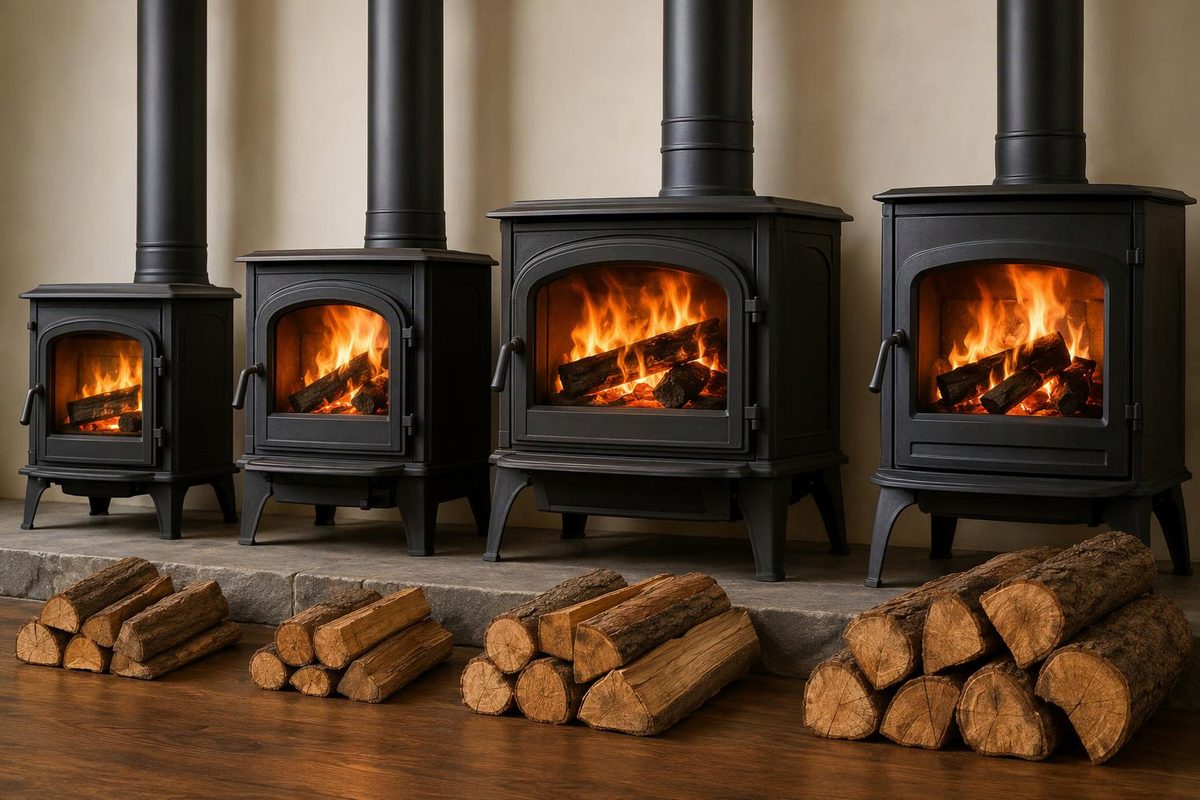
A large log burning stove can offer more room for fuel and longer intervals between reloads. But long-log capacity, fuel capacity and heating capacity are different specifications. Choose the extra firebox space only if the stove’s operating heat range also suits your home.
Before comparing capacity, have the proposed location checked against the exact appliance label and manual: combustible clearances, hearth protection, combustion air and chimney requirements. A larger replacement is not automatically compatible with the existing installation. The HT-3000 installation manual, for example, requires consultation with local building or fire officials about restrictions and inspections. Use our log burner installation checklist for that wider planning task.
Decide what you need the larger firebox to do
Separate your reason for buying large into one of three needs:
- Longer logs: check maximum log length, internal width and depth, and the loading-door opening.
- Fewer reloads: check usable loading space and burn duration at the heat output you actually need.
- More heat in cold weather: compare operating output with a heat-loss assessment of the area the stove will serve.
Large stoves are more plausible candidates for larger open-plan houses or older, leakier homes in cold climates than for a single well-insulated room. That is also the distinction made in EPA’s archived stove-sizing guidance. Take a floor plan to the retailer or installer; total house area alone does not show how heat can reach separate rooms.
Read firebox volume and log length separately
The Drolet HT-3000 illustrates how much detail can sit behind a “large” description. Its published specifications, checked in November 2026, list:
| Capacity check | HT-3000 specification |
|---|---|
| Overall firebox volume | 3.5 ft³ |
| EPA loading volume | 2.88 ft³ |
| Internal width × depth | 22⅞ × 20⅛ inches |
| Maximum log length | 22 inches |
| Recommended fuel length | 16 inches |
| Loading-door opening | 19 × 10⅝ inches |
Overall firebox volume is not permission to fill every available space. Drolet’s manual explains that the overall calculation includes a buffer zone for inserting fuel, limiting ash spillage and allowing the glass airwash to work. It specifically identifies the 22-inch maximum log length as east–west.
Loading direction matters too. North–south means the log ends face the door; east–west means their sides face it. The same manual says north–south loading allows more wood, while east–west loading must be limited to prevent logs falling toward the glass. A 22-inch maximum therefore is not a 22-inch fit in both directions.
Measure several pieces from your wood supply, including the longest and bulkiest. Ask the dealer to demonstrate their fit in a cold display stove within the approved loading area. Drolet recommends cutting logs at least an inch shorter than the firebox dimension they occupy. A maximum-length claim is less useful than easy loading with your normal splits.
Compare the low output—not just the headline maximum
The HT-3000 advertises a maximum dry-cordwood output of 110,000 BTU/h, but separately lists an overall heat-output range of 17,200–57,800 BTU/h (5.0–16.9 kW). Its specification notes explain that the headline maximum uses a different, denser fuel loading than the other performance figures. Those numbers are not interchangeable sizing ratings.
Nor does a large fuel chamber necessarily mean the same minimum output across models. The catalytic Blaze King KE40’s manual reports 10,392–38,516 BTU/h under specific test conditions. This is not a directly matched comparison—the KE40 uses crib-wood certification testing, while the HT-3000 uses cordwood—but it shows why the exact model’s low-output capability deserves attention. Test ranges are comparison points, not guarantees of the output achievable in your installation.
Ask how the stove will operate on ordinary winter days and in milder weather, not only during the coldest spell. If its lowest practical clean-burning output is still more heat than the room needs, a full-load, long-burn routine is a poor fit.
Long burns have a heat-output tradeoff
Drolet advertises up to ten hours for the HT-3000. Blaze King advertises up to forty hours on low for the King 40, while describing much shorter high-heat operation. Both manufacturers qualify duration by installation and fuel conditions. These are Drolet and Blaze King claims, not promises of equivalent useful heat.
Oversizing becomes troublesome when you fill the stove for a long burn, then suppress combustion because the room is too hot. The HT-3000 manual warns that a full firebox in mild weather can overheat the space or require a smoky, inefficient burn. The KE40 manual likewise advises reducing fuel-load volume when heat is excessive rather than turning the thermostat too low; its catalyst must remain active. Low flame activity alone is not evidence of a problem in that catalytic stove—the manual directs users to its catalyst thermometer.
Stop the selection if the proposed operating routine depends on starving the fire. Smaller loads following the model’s instructions may suit mild days, but they surrender some of the full-load duration you bought the large stove to obtain.
Finally, confirm chimney compatibility before committing: the HT-3000 specifies a six-inch flue outlet and connector, while the KE40 specifies eight inches. Have the installer quote any required venting changes alongside the stove. The useful shortlist is the one that fits your logs, provides acceptable heat between reloads, and can be installed to its listing—not simply the models with the biggest fireboxes.