
Log Burning Fans: Check Stove Temperature and Placement First
Learn what heat-powered log burner fans can do, how to check temperature and placement, and when an appliance-approved blower is the better choice.
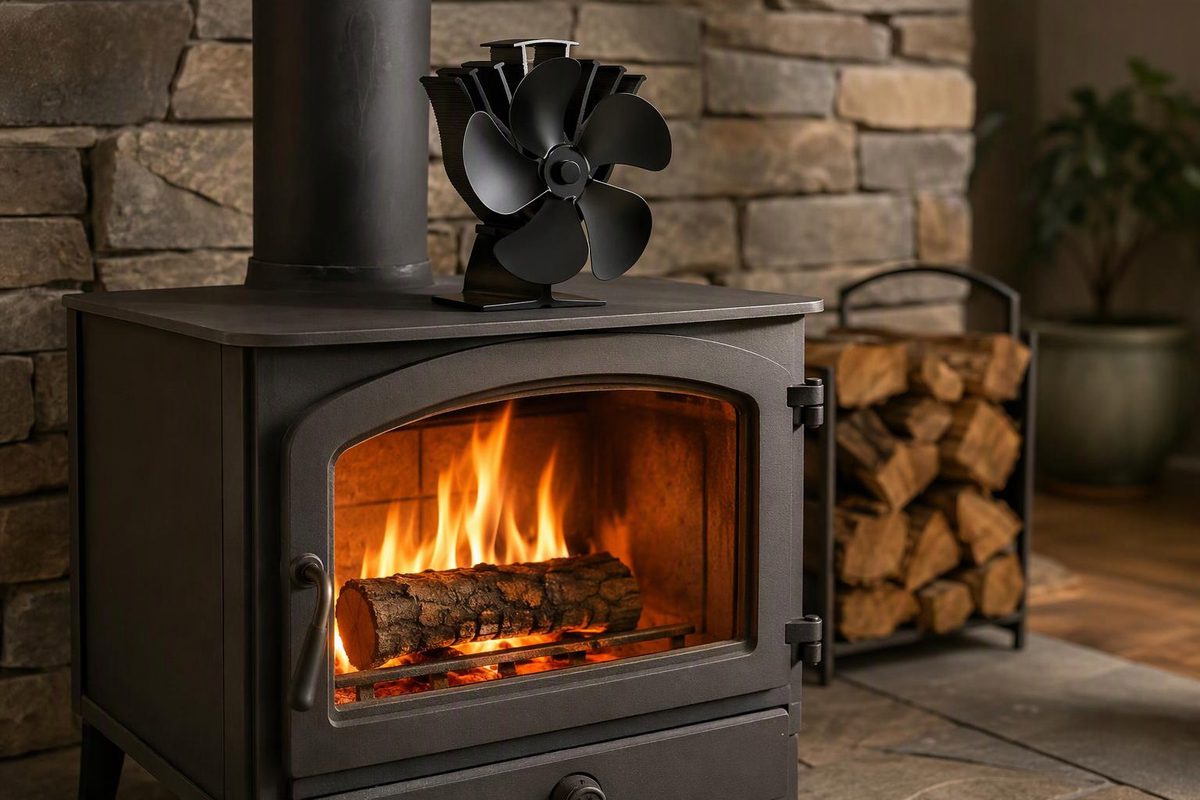
Heat-powered log burning fans can help circulate warmth from a freestanding wood stove into the room. They are a heat-distribution accessory—not another heat source and not a remedy for poor chimney draft.
Before buying one, check whether your stove has a suitable exposed top, measure its temperature at the proposed fan location, and compare that with the exact fan’s instructions. A fireplace insert may need its own appliance-approved blower instead.
Know which type of fan you need
A heat-powered stovetop fan sits directly on the stove. Common thermoelectric models generate electricity from the temperature difference between their hot base and cooler upper fins, powering a small motor without batteries or a wall socket. The cooling fins need access to cooler room air; heating the whole fan is not the objective. Caframo explains this operating principle.
An electric convection blower is part of, or an approved accessory for, a particular appliance. Its mounting, power supply and controls are model-specific. For example, the Pacific Energy Summit Insert LE has twin variable-speed circulating blowers with automatic temperature control and a manual bypass. A stovetop fan is not an equivalent replacement for that system. Summit Insert LE manual, page 8.
For an insert or enclosed fireplace, start with the appliance manual. Caframo notes that mantel surfaces and insert ledges typically do not provide enough conducted heat for its stovetop fans; placing one in front of the fire is not a substitute. Manufacturer’s compatibility guidance.
Do log burner fans work—and save wood?
They can improve heat distribution, but a fuel-saving percentage is not a dependable prediction for your home.
A study coauthored by Caframo and University of Waterloo researchers, using tests conducted in 2010, reported average fuel savings of about 14% while maintaining a prescribed comfort temperature in a controlled test room. It used one wood-stove model, and individual comparisons varied substantially. The paper distinguishes this result from stove efficiency: the fan redistributed warm air, while the operator adjusted the stove to maintain comfort. This was manufacturer-involved research, not an independent comparison of all stove fans. Original fuel-usage study.
The practical buying case is therefore more even warmth in the stove room—not a guaranteed reduction in your wood bill or reliable heating through several closed rooms. For appliance efficiency itself, compare the wood-stove efficiency ratings, rather than adding a fan’s advertised savings to them.
Check fit before airflow claims
Use this sequence before choosing a fan:
- Check the stove manual. Confirm that the intended location is suitable and does not obstruct an outlet, control, lid or required access. Keep the appliance’s clearance requirements unchanged.
- Measure the proposed contact surface during normal operation. Use a stove-surface thermometer suitable for that surface. A stovepipe reading is not the temperature beneath the fan. Caframo specifically recommends measuring where the fan will sit. Selection guidance.
- Match the exact fan’s temperature range. Limits differ even within one brand. Caframo’s 810/812 instructions specify normal surface temperatures of 85–345°C (185–650°F); its 815 Mini instructions specify 110–325°C (230–617°F). These are examples, not universal stove-fan limits. 810/812 instructions; 815 Mini instructions.
- Check the footprint and blade clearance. The base must sit securely, and the blades must clear surrounding objects. Allow cooler air to reach the upper fins.
Also distinguish a claimed starting temperature from a useful-airflow temperature. In the 810/812 manual, the listed minimum stovetop temperatures refer to producing 50 CFM (cubic feet per minute), not simply making the blades turn. Blade movement alone does not establish useful circulation. Manual specifications.
Place it correctly, then diagnose slow running
For Ecofan models, the manufacturer recommends a smooth, flat location near a side or back edge, with cooler air available behind the fins. It warns against placement at the front, in the centre, or directly in front of the stovepipe. Follow your own fan’s diagram rather than assuming this layout fits every product. Placement guidance.
If the fan slows or stops:
- Check the temperature beneath it against its specified range.
- Check whether the upper fins are exposed to excessive heat or blocked from cooler air.
- Once everything is cold, check for blade obstruction or visible damage.
- If temperature and placement are correct, contact the manufacturer about service parts. Caframo identifies slow running or needing a push to start as possible motor-replacement symptoms. Do not push moving blades as a routine workaround. Operating and service instructions.
Do not fire the stove harder just to accelerate the fan. Excess temperature can damage the thermoelectric module. The Ecofan instructions above say to remove the fan if its maximum surface temperature is exceeded. The hot base must not be touched; use the handling method specified in your fan’s manual. 810/812 safety instructions; 815 Mini safety instructions.
Stop treating the problem as a fan issue if smoke leaks into the room or stove parts glow red. Those are draft or overfiring warning signs, not reasons to buy a larger circulator. Follow the appliance’s safety instructions and have the stove and chimney assessed before further use. Pacific Energy’s draft and overfiring guidance, pages 7–8.