
Wood Combustion Fireplace: Start With the Firebox and Chimney
Compare open fireplaces, enclosed wood heaters and inserts, then check chimney compatibility, clearances, heat ratings and safe burning practices.
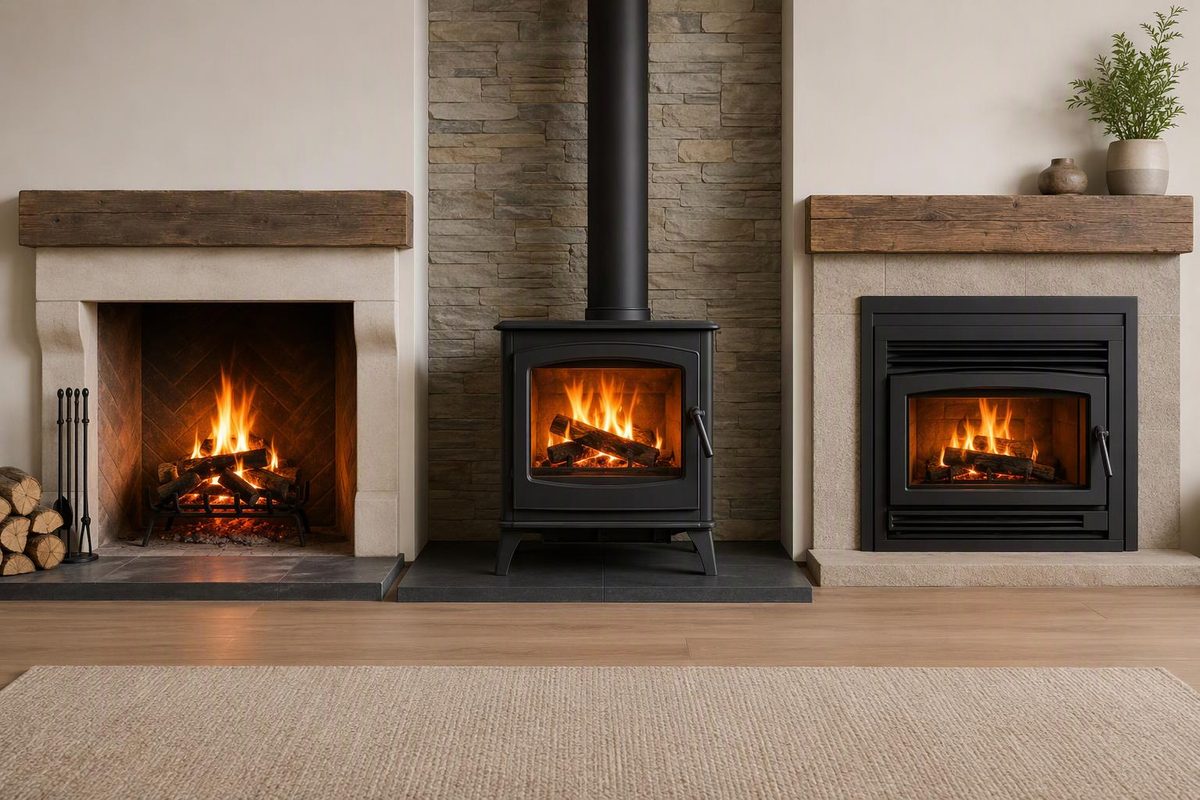
A wood combustion fireplace burns wood, but that description alone does not tell you whether it is an open decorative fireplace, an enclosed built-in heater, or an insert for an existing fireplace. Those are different installations with different chimney, clearance and operating requirements.
If useful room heat is the goal, distinguish an open fireplace from a controlled-combustion heater before comparing appearance or price. Traditional open fireplaces send much of their heat—and heated room air—up the chimney. They are generally better suited to ambiance than dependable space heating. EPA’s archived fireplace guidance explains that distinction.
1. Identify which appliance you have or need
| Type | What it is | First check |
|---|---|---|
| Open wood-burning fireplace | A masonry or factory-built fireplace with an open burning area, often protected by a spark screen | Firebox and chimney condition; operating instructions for any doors |
| Enclosed built-in wood heater | A purpose-built fireplace with a controlled combustion system and a sealed operating door | Exact model, approved chimney system and installation manual |
| Wood-burning fireplace insert | A stove-like appliance installed inside an existing fireplace | Whether that fireplace is approved to accept the proposed insert |
An insert is not simply a built-in fireplace with a different surround. EPA’s appliance guide describes inserts as heaters designed for existing fireplace fireboxes and warns that factory-built fireplace compatibility must be specifically established.
Physical fit is not approval. Some fireplaces prohibit inserts altogether: the RSF Opel Plus manual, for example, explicitly says not to install one in that fireplace. For an existing opening, use our fireplace compatibility checks before selecting an insert.
For an existing factory-built appliance, record the manufacturer, model and serial number from its label. A brick or stone facing does not, by itself, identify the appliance behind it.
2. Understand what “controlled combustion” changes
An enclosed heater controls the air entering its firebox. Cleaner-burning designs also burn more of the combustible material carried in wood smoke:
- Non-catalytic or secondary-combustion designs use a hot firebox, baffles and additional combustion air to burn smoke gases.
- Catalytic designs pass smoke through a coated combustor that enables those gases to burn at lower temperatures.
- Hybrid designs combine both approaches.
These are combustion technologies, not interchangeable operating procedures. EPA’s technical explanation describes the differences.
On a catalytic fireplace, the bypass position and catalyst-engagement procedure matter. Follow the exact manual for lighting and reloading; do not borrow a sequence from another model. The Opel Plus manual, for example, requires the bypass to be open when lighting or reloading.
Likewise, do not assume that glass doors on an open fireplace make it a controlled-combustion heater or permit closed-door burning. Door instructions vary: Forge & Flame’s guidance for wood-burning fireplaces calls for fully open glass doors when starting a fire and while it is burning strongly. Use the instructions for your fireplace and approved doors.
3. Verify the chimney and clearances before ordering
Ask the installer to identify these items in the proposed appliance’s manual and installation plan:
- Approved chimney manufacturer/system and diameter, or the permitted masonry-chimney connection and liner arrangement.
- Minimum and maximum chimney height, permitted offsets and required supports.
- Fireplace enclosure, ceiling, sidewall and mantel clearances.
- Hearth-extension dimensions and required floor protection.
- Combustion-air requirements and any heat-distribution components needed for the chosen facing configuration.
The requirements can be much more specific than “use a wood-rated chimney.” For example, the Opel Plus manual specifies 7-inch ICC EXCEL chimney, provides a separate approved masonry-chimney connection arrangement, and requires particular heat-distribution options when louvers are omitted. It also tells owners to contact the local authority about restrictions, installation requirements and permits.
Stop the purchase if the chimney route or required clearances cannot be demonstrated. Resolve those constraints before choosing a mantel, television location or stone surround. EPA emissions certification does not replace installation instructions or local approval.
Compare heat ratings on the same basis
Do not compare one model’s estimated peak BTU claim with another model’s laboratory output, or a lower-heating-value (LHV) efficiency with a higher-heating-value (HHV) efficiency.
The Opel 3 Plus specifications, checked in October 2026, illustrate the problem: the manufacturer lists 27,034 BTU/hr based on certification testing alongside an estimated 70,000 BTU/hr potential calculated from operating assumptions. It also lists 70% average HHV efficiency and 80% optimal LHV efficiency. These figures differ in measurement basis and rating conditions; they are not directly interchangeable.
Use comparable tested figures and the building’s heat loss to assess suitability. A square-footage range alone cannot account for insulation, climate or room layout.
4. Check the fuel and establish stop points
For cordwood, test several representative pieces on a newly split interior face, following the moisture meter’s instructions. EPA’s moisture-meter flyer recommends wood below 20% moisture content and explains that wet wood produces less heat and more smoke and creosote. Time in a stack is not a substitute for testing.
Burn only fuel allowed by the appliance manual. Do not burn trash, painted or pressure-treated wood, plywood or other glued wood products. Manufactured firelogs are not automatically suitable for enclosed heaters. EPA’s burning guidance covers those fuel restrictions and recommends storing ashes outdoors in a covered metal container on a noncombustible surface.
Have the chimney professionally inspected and cleaned annually; follow any more frequent checks required by the manual or operating conditions. Keep the ash container at least 10 feet from the home. U.S. Fire Administration guidance supports these precautions.
Repeated smoke spillage calls for assessment, not a hotter test fire. Possible causes include chimney blockage, inadequate chimney height and house depressurization from exhaust fans, as described in the Opel Plus troubleshooting instructions. Stop using the fireplace until the cause is corrected.
Keep working smoke and CO alarms installed according to their instructions and local requirements. If a CO alarm sounds or you suspect CO poisoning, move everyone outside immediately and call emergency services. Do not stay inside to diagnose the fireplace or reenter until responders give permission. Follow the CPSC’s CO emergency guidance.