
How to Specify Clay Flue Tile Without Guessing the Size
Compare nominal, inside and outside dimensions with verified effective flue area, appliance requirements, chimney geometry and locally adopted code.
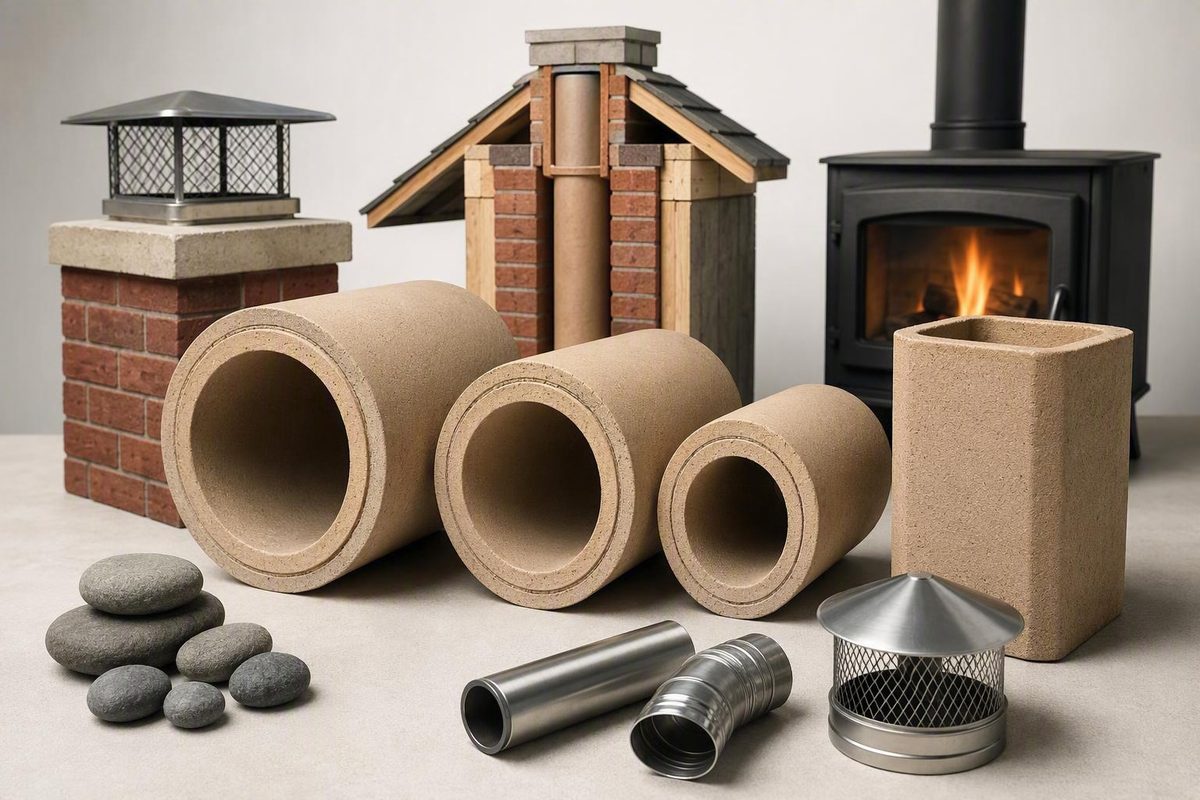
Select a clay chimney flue liner by the fireplace or appliance requirements, verified effective flue area, chimney geometry, and locally adopted code—not by a nominal product label or connector diameter alone. Before ordering, obtain current manufacturer data that distinguishes nominal, inside, outside, and actual dimensions and identifies the required joints and fittings.
What a clay chimney flue liner is—and what it is not
A clay chimney flue liner is a passage formed from vitrified-clay sections inside a masonry chimney. It carries combustion products toward the termination while separating the flue passage from the surrounding masonry.
Those sections are components of a complete chimney assembly. Individual tiles do not constitute a complete chimney, and clay tile by itself is not an insulated venting system.
A chimney flue liner is also distinct from a fireplace smoke chamber:
- The smoke chamber is the transition above the firebox and below the flue.
- The flue liner forms the passage extending through the chimney.
- A clay product intended for one location should not automatically be specified for the other.
- A smoke-chamber requirement does not necessarily establish the required thickness, material, or joint construction of chimney flue tile.
Product catalogs can identify available shapes, fittings, dimensions, and effective areas. That requires the appliance instructions or listing, the applicable fireplace-sizing provisions, the complete locally adopted code, and verified product documentation.
Flue tile, ring, tee, opening, and thimble: know what is being quoted
Related product names do not all describe an ordinary straight liner section:
- Flue tile or liner section: A straight section forming part of the vertical flue.
- Flue ring: A shorter clay component offered in various diameters and lengths.
- Flue tee: A formed fitting that provides a branch or entry into the flue.
-
Tile with an opening: A liner section manufactured with a preformed opening.
-
Socket-joint or self-aligning section: A description of joint geometry, not simply the tile’s overall shape.
Superior Clay distinguishes socket-joint and self-aligning round liners from contoured rings, tees, and tiles manufactured with openings. It also lists flue rings separately from standard liner sections, so those descriptions are not interchangeable order terms. See the manufacturer’s clay flue liner configurations.
Supplier terminology is not fully standardized. Oneonta Block Company separately lists standard liners, liners with holes, and clay thimbles. Its thimble listings include 6-, 7-, and 8-inch sizes in 12- and 24-inch lengths, but the page does not establish compatibility with every liner brand, joint system, or application. Those distinctions appear in its chimney-item catalog.
Do not select an entry fitting—or decide to cut an opening—from the component name alone. Ask the system manufacturer, chimney designer, or installer to specify the fitting, opening dimensions and orientation, joint style, and approved joint material for the planned assembly.
How to size a clay liner without relying on the label
Collect the following information before comparing products:
| Item to identify | Information to collect | Who or what confirms it | Why it matters |
|---|---|---|---|
| Appliance or fireplace | Make, model, rating, and listing; or fireplace opening dimensions | Appliance documentation, plans, or designer | Establishes the controlling sizing method |
| Fuel | Wood, gas, oil, pellet, or other approved fuel | Appliance documentation and installer | Venting needs differ by appliance and fuel |
| Connector | Verified size and configuration, if applicable | Appliance manual and installer | Affects the connection but does not alone determine liner size |
| Chimney geometry | Height, shape, offsets, bends, and termination | Field survey and chimney professional | Affects draft, fit, and required fittings |
| Existing liner | Inside geometry, accessible outside dimensions, openings, joints, and condition | Inspection and measurements | Determines fit and whether repair is appropriate |
| Effective flue area | Required area and verified product area | Governing sizing provision and manufacturer data | Allows a like-for-like comparison |
| Local requirements | Adopted code, amendments, permits, and inspections | Building department or authority having jurisdiction | Establishes the legally controlling provisions |
Flue size affects the operation of the complete system. Rockford Chimney Supply, a stainless-steel-liner seller, says an oversized wood-stove flue may warm slowly, weaken initial draft, and contribute to smoke condensation or creosote. It also associates oversized gas and oil flues with condensation. These are commercial cautions, not a diagnosis for every chimney; the appliance and flue must be evaluated as one system. The seller explains its reasoning in a comparison of clay and stainless-steel liners.
Use this workflow:
- Collect system data. Record the appliance identification or fireplace opening, fuel, connector, chimney height, offsets, and existing flue dimensions.
- Identify the controlling sizing method. Start with the appliance instructions or listing for a connected appliance and the complete adopted code for a masonry fireplace.
- Obtain product documentation. Request current inside and outside dimensions, effective flue area, section length, joint details, and manufacturer drawings.
- Compare like with like. Compare required effective area with verified effective area, not a round inside diameter with a rectangular outside dimension.
- Review the complete assembly. Have the proposed liner, joints, fittings, connection, masonry construction, and termination checked before purchase.
Common shapes, dimensions, and effective flue areas
Clay liners are sold in round, square, and rectangular configurations. Superior Clay lists round vitrified-clay liners from 3 to 36 inches in diameter and square or rectangular products from 4 × 8 through 24 × 24 inches. Its chart assigns an effective flue area to each listed product rather than asking buyers to infer area from the product name. The selected figures below come from the manufacturer’s size and effective-area chart.
| Shape | Listed dimension | Dimension basis | Effective area |
|---|---|---|---|
| Round | 4 in. | Normal inside diameter | 12 sq. in. |
| Round | 8 in. | Normal inside diameter | 50 sq. in. |
| Round | 12 in. | Normal inside diameter | 113 sq. in. |
| Round | 36 in. | Normal inside diameter | 989 sq. in. |
| Rectangular | 8 × 8 in. | Approximate outside dimensions | 42 sq. in. |
| Rectangular | 8.5 × 13 in. | Approximate outside dimensions | 76 sq. in. |
| Rectangular | 13 × 13 in. | Approximate outside dimensions | 127 sq. in. |
| Rectangular | 24 × 24 in. | Approximate outside dimensions | 431 sq. in. |
These values apply to that manufacturer’s product line. Do not transfer them to another manufacturer’s tile merely because the nominal labels look similar.
The terms in a catalog also have different meanings:
- Nominal size is a product designation and may not be an exact measurement.
- Actual size is a measured or manufacturer-specified physical dimension.
- Inside dimension describes the opening through the tile.
-
Outside dimension describes the exterior envelope and affects fit within the masonry.
-
Approximate dimension is not a guaranteed fit or fabrication tolerance unless the manufacturer defines it as such.
A round inside diameter and an approximate rectangular outside dimension do not measure the same thing. Even when their labels contain the same nominal number, their effective areas and exterior envelopes can differ.
Retail listings may further complicate identification. One Menards page titles its product an “8-inch ID × 24-inch clay round flue,” while the description gives approximately square inner and outer dimensions. Other listed measurements and product-versus-shipping weights also conflict. Do not resolve those discrepancies by assumption; obtain a manufacturer drawing or physically verified specifications for the exact model shown in the contradictory retailer listing.
What the cited IRC provisions establish—and what they do not
The cited International Residential Code material is model-code information, not proof of what currently governs a particular property. The ICC identifies the 2021 IRC page as a historical edition. Its summary specifies solid masonry units, or hollow masonry units grouted solid, with at least 4-inch nominal thickness for chimney walls containing flue lining. In the cited reinforcement context, grout must be prevented from bonding to the liner so the liner can move with thermal expansion.
The 2006 IRC excerpt contains the same summarized 4-inch nominal masonry-wall requirement and thermal-movement language. Because it is an older model-code edition, it does not establish current local requirements.
The 2021 excerpt also permits vitrified clay at least 5/8 inch thick in a specified fireplace smoke-chamber lining application. That provision must not be converted into a general requirement that chimney flue tiles be 5/8 inch thick. The smoke chamber and chimney flue are different parts of the assembly.
The code summaries refer readers to other sections for effective flue area and spacing between adjacent flues. A summary table cannot replace the complete adopted provisions, definitions, exceptions, referenced standards, and local amendments.
Before treating a proposed assembly as compliant, verify:
- [ ] Project jurisdiction and responsible building department
- [ ] Adopted code edition
- [ ] State and local amendments
- [ ] Complete masonry-fireplace and masonry-chimney provisions
- [ ] Effective-flue-area requirements
- [ ] Adjacent-flue spacing and masonry requirements
- [ ] Referenced material and installation standards
- [ ] Appliance instructions and listing, where applicable
- [ ] Permit requirements
- [ ] Required inspections and approval stages
This is a verification checklist, not a complete installation or compliance specification.
Cracks, displaced joints, and suspected liner damage
Cracks, open joints, displaced sections, missing material, and visible deterioration warrant evaluation rather than an improvised repair.
Rockford Chimney Supply identifies chimney fires, rapid temperature changes, and climate exposure as possible causes of clay-tile cracking. The seller also warns that cracks may create a path for flue gases, including carbon monoxide. Those claims support investigating the chimney, but they do not establish that every crack has the same severity or that one repair method is always required. See its discussion of cracked clay flue tiles.
Depending on the inspection findings, a proposed remedy might involve accessible clay-section work, another compatible liner system, or broader chimney reconstruction. The evidence does not support choosing among those options without considering access, appliance requirements, chimney geometry, surrounding construction, and local approval.
Have the chimney evaluated by a qualified chimney professional, particularly after a suspected chimney fire or where flue-gas leakage may be possible. Do not resume use solely because a crack appears small from one viewing angle.
Buyer checklist before ordering clay flue components
Use this checklist for a written quote or purchase order. Ask the supplier to distinguish manufacturer specifications from retailer descriptions or handwritten stock labels.
Product specifications
- [ ] Manufacturer and exact product or model
- [ ] Shape: round, square, or rectangular
- [ ] Nominal size
- [ ] Verified inside dimensions
- [ ] Verified outside dimensions
- [ ] Effective flue area
- [ ] Section length
- [ ] Wall thickness
- [ ] Manufacturing tolerances where fit is critical
- [ ] Joint style and orientation
- [ ] Approved joint material
- [ ] Required tee, ring, thimble, or preformed opening
- [ ] Opening dimensions and location
- [ ] Applicable material standard or listing
- [ ] Current manufacturer drawing or data sheet
Project requirements
- [ ] Appliance make, model, fuel, and instructions—or fireplace opening dimensions
- [ ] Compatibility with the required effective flue area
- [ ] Chimney height and flue path
- [ ] Offsets and changes in direction
- [ ] Existing liner condition and geometry
- [ ] Installation or reconstruction access
- [ ] Required section and fitting quantities
- [ ] Termination details
- [ ] Permit requirements
- [ ] Inspection requirements
- [ ] Written confirmation of appliance and code compatibility
Purchasing terms vary by seller. Oneonta uses quote requests rather than displayed prices. Capitol City Lumber describes its clay sections as individually sold, available for local pickup rather than shipping, and eligible for special ordering when a size is unavailable. Menards identifies its example as special-order merchandise.
The Menards page also displays a mail-in rebate stated to run through September 13, 2026. It describes that rebate as credit toward a future in-store purchase rather than an immediate reduction in the original transaction. Because price, promotion, and availability depend on time and store context, treat the retailer offer only as an example of changing purchasing terms—not as a project-cost estimate.
Before paying, ask five questions:
- Which dimensions are inside dimensions, and which are outside, actual, or nominal dimensions?
- What is the verified effective flue area of this exact product?
- Which joint style and fitting system applies to the planned assembly?
- What manufacturer documentation, standard, listing, and approved joint material govern installation?
- Who will confirm compatibility with the appliance or fireplace and the locally adopted code?
Choose from verified requirements, not the name stamped on a tile. Confirm the controlling sizing method, effective area, dimensions, fittings, joints, and local requirements before ordering. If an existing liner is cracked, displaced, or associated with a suspected chimney fire or flue-gas leak, obtain a professional inspection instead of selecting a repair from a generic product chart.