
What You Should Really Budget for a Chimney Sweep
$150–$400 is a practical starting budget for a routine sweep. Inspection scope, pricing unit and add-ons show whether two quotes cover the same work.
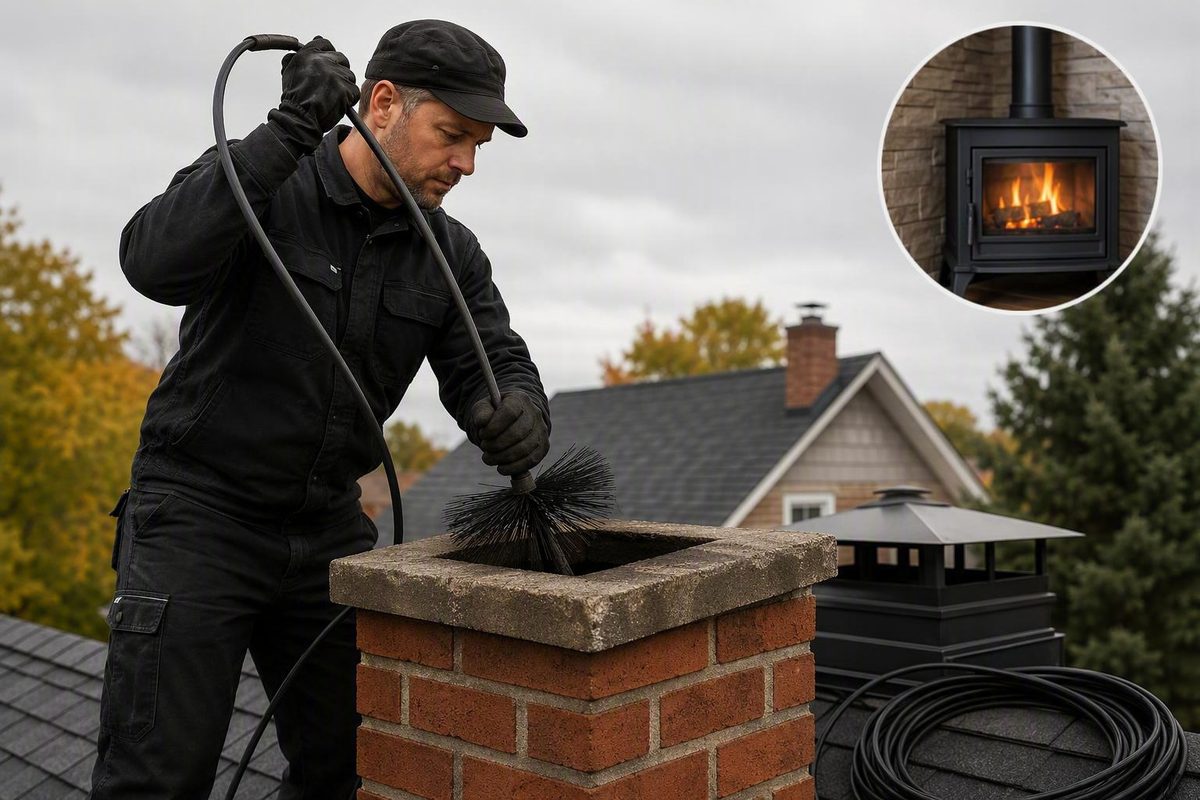
The short answer: A practical chimney-cleaning budget
For a routine professional chimney sweep in the United States, $150–$400 is a useful starting budget. Several published estimates cluster near $250, but the scope of work matters more than the headline average. A basic sweep, a sweep with a documented inspection, and a visit involving hardened deposits or an obstruction are materially different services. Best Pick Reports publishes a national estimate of $120–$400, averaging about $250. See its chimney-cleaning cost overview.
For more specific planning:
- Sweep only: commonly about $150–$350
- Cleaning with an inspection: approximately $200–$500
Housecall Pro’s 2026 pricing guide lists $150–$350 for a standard sweep and $200–$400 for cleaning with a Level 1 inspection. These are planning ranges, not fixed national rates. See Housecall Pro’s chimney-cleaning price guide.
A practical household budget can be organized into three scenarios:
- Maintained, accessible, single-flue system: $150–$300. This assumes routine deposits, straightforward access, and no unusual appliance removal or specialized treatment.
- Routine cleaning with an inspection: $200–$500. This is a reasonable allowance when the provider bundles cleaning with a defined inspection or when you want documentation beyond an informal visual check.
- Neglected or complicated system: $500–$1,000 or more. Heavy deposits, a blocked flue, camera work, difficult roof access, a more extensive inspection, or repairs can move the total well beyond routine-maintenance pricing.
The third range is a budgeting allowance synthesized from published cleaning, inspection, obstruction-removal, and repair estimates. It is not a standard package price. Labor rates, travel, taxes, service-area demand, chimney height, roof conditions, flue count, appliance type, and buildup all affect the final quote.
Two prominent cost pages—Angi and HomeAdvisor—both publish a $254 average and a normal range of $129–$381. Review HomeAdvisor’s published chimney-sweep range.
Local prices may sit above or below those national figures. As one clearly limited example, a provider serving southeastern Wisconsin advertises $355 for a single-fireplace sweep with inspection. That is one company’s listed service price—not a Wisconsin average—and its inclusions still need to be compared with other local quotes. See the provider’s advertised sweep prices.
| Service scope | Practical U.S. planning range | What the figure generally represents |
|---|---|---|
| Routine sweep | $150–$350 | Ordinary soot and deposit removal for a serviceable system; inspection scope varies |
| Sweep plus inspection | $200–$500 | Cleaning accompanied by a defined inspection or visual evaluation; documentation varies |
| Basic per-flue work | About $250–$322 per flue | Basic work under favorable, readily serviceable conditions in Homewyse’s January 2026 model |
| Complex or add-on-heavy service | $500–$1,000+ | A planning allowance for severe deposits, advanced inspection, blockage removal, difficult access, or component work |
The per-flue figure comes from Homewyse, while the other rows synthesize the published routine-service and add-on ranges discussed throughout this article. Examine Homewyse’s per-flue cost assumptions.
Use the table as a budgeting tool, not as a national rate card. When comparing the cost to clean a chimney, determine whether each estimate covers the same number of flues, inspection depth, access work, documentation, and cleanup.
Why published chimney-sweep prices differ
Online estimates can range from under $150 to more than $500 because they often describe different products.
One price may cover brushing a readily accessible flue. Another may include a basic visual review, photographs, and firebox cleanup. A third may combine cleaning with a formal inspection. Still another may reflect heavy-deposit treatment, cap removal, camera work, appliance disassembly, or obstruction removal. Calling all of these services a “chimney sweep” makes the prices appear more inconsistent than they are.
The pricing unit also changes the comparison. A residential flat rate might apply to:
- One service visit
- One visible chimney structure
- One fireplace or stove
- One individual flue
- A base service plus a charge for each additional flue
A masonry chimney can contain more than one flue. If two appliances vent through separate passages, the technician has separate cleaning work even though both flues are housed within the same visible structure. Comparing a per-visit quote with a per-flue quote can therefore make one provider seem cheaper when the scopes are simply different.
Homewyse’s January 2026 model illustrates the problem. It estimates approximately $250–$322 per flue for basic work under favorable, readily serviceable conditions. Its modeled scope includes work-area preparation and protection, sealing the fireplace opening, removing and securing the cap, brushing the flue, vacuuming the firebox, setup, and cleanup.
The model excludes sales tax, permits, inspection fees, hazardous-material work, and repairs or modifications not listed in the estimate. It is useful because it identifies both the pricing unit and the assumed conditions. It should not be read as the price for every fireplace, an entire multi-flue chimney, or an inspection-and-cleaning package.
National figures have another limitation: most available estimates come from home-service marketplaces, business-software companies, cost calculators, or individual service providers. These are useful commercial benchmarks, but they do not form a neutral national tariff. Geographic weighting, service definitions, data age, and methodology can differ or remain unclear.
Repeated averages can also create false precision. If several articles quote or reuse the same marketplace data, seeing the same $254 figure on multiple pages does not mean that several independent national surveys reached exactly the same result. A realistic range is more defensible than one supposedly exact nationwide average.
All prices in this article are U.S. estimates. Chimney-service prices from the United Kingdom reflect a different currency, tax structure, labor market, and service context. Converting those figures into dollars would not create a reliable U.S. benchmark.
What a standard chimney sweep usually includes
A standard appointment generally centers on controlling dust and removing deposits from the venting passage. Depending on the appliance and chimney configuration, the technician may work from below, above, or through a combination of access points. There is no universal cleaning sequence for every masonry fireplace, factory-built chimney, wood stove, pellet appliance, or insert.
A routine service may include:
- Protecting the floor and nearby furnishings
- Sealing or controlling the fireplace opening
- Brushing or mechanically sweeping the flue
- Removing soot, loose creosote, ash, and debris
- Vacuuming the firebox or accessible appliance area
- Removing and resecuring the chimney cap when required for access
- Cleaning the immediate work area
- Conducting a basic visual review of accessible components
Some providers include before-and-after photographs, written findings, or a condition report. Others supply documentation only with a separately defined inspection. Do not assume that pictures or a written report are included merely because the estimate uses the word “inspection.”
The southeastern Wisconsin provider cited earlier gives a concrete example of one company’s scope: its advertised single-fireplace service includes brushing from the fireplace floor to the chimney top, a general inspection, and a report or pictures as needed. Its older-insert service may require removing the insert to clean and inspect the system properly. Review the provider’s stated cleaning scope.
Those are provider-specific inclusions, but they illustrate why two seemingly similar sweeps may involve different amounts of work.
The provider may use “inspection” informally, or it may perform a defined inspection without supplying a detailed written report. Ask how the company defines the service, which areas are evaluated, whether it assigns an inspection level, and how findings are recorded.
Before accepting a base quote, confirm these essentials:
- Pricing unit and flues: Is the price per visit, appliance, chimney, or flue, and how many flues are included?
- Appliance access: Must a stove, connector, insert, damper, or baffle be disconnected or removed?
- Cleaning scope: Which passages, chambers, and appliance areas will be brushed or vacuumed?
- Work-area protection: Are floor coverings, fireplace sealing, and dust controls included?
- Cap handling: Is cap removal and reinstallation included if required?
- Inspection: Is the service an informal visual check, a documented inspection level, or cleaning only?
- Documentation: Are photographs or written findings included?
- Cleanup: Will the company remove the soot and debris generated by its work?
- Extra charges: Are travel, tax, disposal, access equipment, and return visits included?
The lowest advertised price is not necessarily the lowest total or the best value. A $175 sweep that excludes inspection, cap access, a second flue, tax, and cleanup may cost more in practice than a clearly itemized $300 package.
Cleaning versus Level 1, Level 2, and Level 3 inspection costs
Cleaning and inspection are related but distinct tasks. Cleaning physically removes deposits and debris. Inspection evaluates accessible portions of the chimney, venting system, and connected appliance to the depth promised by the provider.
A technician may perform both during the same visit, but inspection depth and documentation can vary substantially. A quick look at accessible surfaces is not automatically equivalent to a separately ordered, documented inspection.
Angi publishes the recurring mainstream ranges shown below. Its broader guide also identifies condition, flue count, accessibility, appliance type, and inspection level as cost variables. See Angi’s chimney-sweep and inspection estimates.
| Inspection label | Published planning range | Important scope qualification |
|---|---|---|
| Level 1 | Approximately $160–$300 | May describe inspection alone or a basic inspection-and-cleaning package |
| Level 2 | Approximately $260–$460 | More detailed evaluation; cleaning may or may not be included |
| Level 3 | Approximately $500–$800 | A mainstream cost-guide range, not a universal ceiling |
These figures require careful interpretation. Some providers use them for inspection-only work, while others bundle the inspection with sweeping. Before comparing prices, ask whether physical cleaning is included and whether the quoted amount covers one appliance, one flue, or the whole visit.
A Level 2 evaluation generally costs more than a basic visual review because it represents a more detailed service. One Wisconsin provider describes its real-estate inspection as “often” being Level 2. That local example does not establish a universal rule for property transactions or determine which level a particular system requires.
Level 3 pricing is especially difficult to summarize. The Stove Shop publishes conflicting figures on the same page—$1,000–$10,000 or more in one section and $1,000–$5,000 or more in another. Compared with the $500–$800 figures in mainstream guides, that inconsistency demonstrates why no single upper limit is defensible. Compare the provider’s inspection ranges and qualifications.
The total depends on what must be accessed, opened, evaluated, restored, or repaired. Without relying on a price label alone, ask:
Is the inspection an informal visual check, a documented Level 1, or a more extensive evaluation, and is cleaning included?
Also ask why that level is being recommended, which areas it covers, what equipment will be used, what documentation you will receive, and whether any opening or restoration work is included. A homeowner should not have to infer the inspection scope from the price.
The factors that move your quote up or down
Deposit severity and maintenance history
Creosote and soot severity can have an important effect on cleaning labor. A routinely maintained flue with ordinary removable deposits is different from a neglected system with substantial hardened material. The latter may require more time, different tools, specialized treatment, or a return visit.
Tell the estimator when the system was last serviced and how heavily it has been used. If you do not know, say so rather than assuming the chimney qualifies for a routine sweep.
Roof, chimney, and appliance access
A steep roof, tall chimney, multistory house, restricted workspace, fragile roofing surface, or difficult cap location can require more setup and labor. The provider may need specialized access equipment, safety systems, or another worker.
Interior access can also be complicated. Inserts, connector pipes, stove components, dampers, baffles, or decorative assemblies may have to be moved or removed. Ask whether that labor is included instead of assuming the advertised base rate covers it.
Number of flues
Each flue is a separate passage requiring attention. A chimney structure serving a fireplace and another heating appliance may therefore involve more work than a visually similar single-flue chimney.
Ask the estimator to state the number of flues included and the charge for each additional flue. “One chimney” is not precise enough for meaningful quote comparison.
Appliance and system type
Appliance design, fuel, vent arrangement, and deposit type influence the service procedure. HomeAdvisor lists approximately $80–$130 for gas-fireplace maintenance, $130–$200 for pellet-stove inspection and cleaning, and $150–$300 for standard wood-stove upkeep. These are starting points, not promises that every appliance can be serviced for those amounts. See HomeAdvisor’s appliance-specific ranges.
Confirm whether the quote covers the appliance itself, its venting, the chimney, or all three. For a pellet appliance, for example, “stove cleaning” and “vent cleaning” may not describe identical work.
Age and configuration
Older masonry systems may take more time to evaluate, particularly when access is limited or deterioration is visible. Older fireplace inserts can also create complications.
One southeastern Wisconsin provider lists $429 plus tax for an older insert without an attached liner because removing the insert may be necessary for proper cleaning and inspection. This is a provider-specific local price, not a general surcharge.
The broader lesson is to tell the company about an insert, liner arrangement, or unusual appliance before dispatch. Advance disclosure makes it easier for the provider to identify potential removal work and quote it separately.
Location, travel, condition, and timing
Local labor rates and operating costs affect the base price. A remote property may incur mileage or an extended-service-area charge.
Late summer and fall are described as busy periods in several commercial cost guides. Booking earlier may improve appointment availability and could affect pricing, but an off-season discount is not guaranteed. Emergency and after-hours visits may also carry premiums, although not every company offers or separately charges for them.
Yelp lists $90–$280 per chimney as a national estimate and identifies severe buildup, difficult access, season, location, and emergency service as possible cost drivers. Its estimates are based on U.S. business quotes and user interaction data. Review Yelp’s stated chimney-sweep cost factors.
Place your system in a likely budget tier
Before requesting estimates, answer these questions:
- What fuel and appliance type do you have?
- How many flues need service?
- When was each flue last cleaned or inspected?
- Is there a known or suspected blockage?
- Is the chimney readily accessible from the roof or interior?
- Will a stove, insert, baffle, or connector need removal?
- Are you requesting routine cleaning, a documented inspection, or a more extensive evaluation?
- Have there been changes, leaks, damage, or long periods without use?
If you cannot answer everything, send photographs of the fireplace or appliance, chimney exterior, roofline, and accessible equipment labels when requesting a quote. The provider may still need an on-site assessment, but better information can reduce avoidable estimate changes.
Heavy creosote, nests, and other common add-on costs
Routine soot removal should remain separate from specialized deposit treatment, obstruction removal, and repairs. When all four are grouped under “chimney cleaning,” the estimate becomes difficult to evaluate.
The following amounts synthesize published ranges from Housecall Pro, HomeAdvisor, and The Stove Shop. Where two sources disagree, the figures are kept as separate alternatives rather than averaged.
| Work category | Published planning amount | How to interpret it |
|---|---|---|
| Routine sweeping | About $150–$350 | Base removal of ordinary soot and deposits; inclusions vary |
| Specialized heavy-creosote treatment | Additional $100–$300+, or $400–$900+ for severe treatment in another guide | Severity, method, labor, and repeat visits can produce substantially different quotes |
| Camera liner inspection | About $100–$250 | Applies where camera work is separately charged |
| Animal or nest removal | Roughly $100–$560 | Synthesized endpoints from different guides; access, animal type, blockage, and damage matter |
| Chimney-cap installation | About $150–$500+ | Product choice, chimney dimensions, and roof access affect the total |
| Deep smoke-chamber cleaning | About $75–$200 | One published add-on range, not a universal fee |
| Repairs | From low hundreds to several thousand dollars | The component and project scope determine the price |
Ordinary sweeping and treatment of severe or glazed deposits are not the same price category. Homeowners should not attempt to diagnose the deposit type from an online description. Instead, ask the technician to document what was found and explain why work beyond routine mechanical sweeping is being recommended.
Housecall Pro lists heavy-creosote removal as an additional $100–$300 or more, camera liner inspection at $100–$250, cap installation at $150–$500 or more, animal-nest removal at $100–$400, and deep smoke-chamber cleaning at $75–$200. See the guide’s itemized add-on ranges.
By contrast, The Stove Shop publishes $400–$900 or more for heavy-creosote treatment. These amounts should not be averaged into a supposedly precise midpoint. They likely describe different assumptions about severity, treatment, labor, and service scope.
Animal-removal figures are similarly broad. Housecall Pro lists $100–$400, while HomeAdvisor lists $180–$560, producing the synthesized planning span shown in the table. A reachable abandoned nest is not equivalent to a live-animal problem, severe blockage, or work requiring specialized access.
Before booking, ask the estimate to explain:
- The price or approval process for specialized deposit treatment
- Whether camera work is included or separately charged
- How animal and nest removal is priced
- Whether cap removal and reinstallation are included
- What conditions would trigger a return visit
- Whether a second visit has a separate minimum charge
- How removed material will be handled
- Whether tax and disposal are included
A provider should obtain authorization before performing unquoted extra work. If a blockage, severe deposit, or damaged component is discovered, request a revised price or itemized proposal before the service expands beyond the agreed scope.
When a cleaning visit turns into a repair project
A sweep is maintenance. Liner replacement, masonry correction, flashing work, and component replacement are repairs. Keeping those categories separate prevents a roughly $250 maintenance appointment from turning into an unexplained four-figure invoice.
Common separately priced work includes:
- Chimney-cap replacement or installation
- Damper repair or replacement
- Waterproofing
- Flashing repair
- Liner repair or installation
- Repointing and other masonry work
- Crown, chase-cover, or structural correction
- Work on damaged appliance connections or vent components
Repair prices can exceed the sweep charge. Damper work is commonly listed in the low hundreds, flashing work may range from hundreds to more than $1,000, and liner projects can run from hundreds to several thousand dollars depending on whether the work is limited or involves a new installation.
Angi lists chimney-cap work at $75–$500, flashing repair at $400–$1,600, and liner installation at $1,500–$5,000. These are broad project estimates rather than fixed add-on prices. Review Angi’s listed repair-cost examples.
This is how a routine visit near $250 can become a $500–$1,000-plus project: the base sweep is joined by specialized deposit treatment, camera evaluation, animal removal, an upgraded inspection, or component work. A major liner, masonry, flashing, or structural project can take the total much higher.
If a defect is reported, request:
- Written findings describing the observed condition
- Photographs or video when available
- A separately identified diagnostic or inspection charge
- An itemized repair proposal
- An explanation of why the work is recommended
- A statement of what is and is not included
- Clarification of whether declining the repair changes the cleaning or inspection fee
Do not use a national cost guide to decide whether a specific defect can wait. That judgment depends on the actual system, the observed condition, the connected appliance, and requirements applicable to the installation. Obtain an appropriate on-site evaluation and consult the appliance and venting documentation for your system.
Cleaning and inspection can identify deposits, blockages, and visible defects. They do not guarantee that a chimney fire, carbon-monoxide incident, concealed failure, or future repair will never occur.
How to get and compare accurate local quotes
National price ranges cannot account for your ZIP code, taxes, roof pitch, travel distance, labor market, appliance configuration, or flue count. The most reliable next step is to obtain written, itemized local estimates.
Give each provider the same information. Identify the appliance and fuel, state how many flues may need service, disclose the last known service date, and mention any insert, liner, access issue, blockage, odor, animal activity, or visible damage. Consistent information makes the estimates easier to compare.
Use a worksheet like this:
| Quote item | Provider A | Provider B | Provider C |
|---|---|---|---|
| Pricing unit: visit, chimney, appliance, or flue | |||
| Number of flues included | |||
| Appliance and fuel type | |||
| Cleaning scope | |||
| Inspection level or visual-review scope | |||
| Steep-roof or multistory access fee | |||
| Travel or call-out charge | |||
| Cap removal and reinstallation | |||
| Appliance or insert removal | |||
| Photographs included | |||
| Written findings included | |||
| Cleanup and disposal | |||
| Tax | |||
| Optional services and prices | |||
| Approval process for extra work | |||
| Return-visit charge | |||
| Total quoted price |
At minimum, ask every company:
- Is the price per visit, chimney, appliance, or individual flue?
- How many flues are covered?
- Does the service include a basic visual review or a documented inspection level?
- Is physical cleaning included in the inspection price?
- Are steep-roof equipment and multistory access included?
- Does the estimate cover cap, appliance, connector, baffle, or insert removal?
- Are travel, tax, disposal, and cleanup included?
- Are photographs or written findings provided?
- What will an additional flue cost?
- How are heavy deposits, animal removal, and camera work priced?
- Is there a separate charge for a return visit?
- Must you approve additional work before it begins?
Avoid vague packages that combine cleaning, inspection, and repair without itemization. You should be able to distinguish the price of routine sweeping from the cost of evaluating a problem and the price of correcting it.
Scheduling before peak fall demand may improve availability and could affect the quote in some markets, but do not assume early booking guarantees a discount. Ask about the provider’s actual pricing.
Finally, compare value rather than price alone. A $225 quote covering one flue and an informal visual check is not automatically better than a $350 quote covering cleaning, a documented inspection, photographs, and cleanup. Conversely, the higher quote is not automatically superior unless the additional scope is relevant and clearly described.
Frequently asked questions
Does chimney-cleaning cost apply per chimney, per flue, or per visit?
It can apply to any of those units. Many residential companies offer a flat service rate, but that rate may cover one visit, one appliance, one visible chimney structure, or one flue. Homewyse, for example, models basic cleaning per flue, while other guides discuss whole-service averages.
Ask the written estimate to state the pricing unit and exact number of flues included. If the visible chimney contains separate passages for multiple appliances, do not assume one base price covers all of them.
Does a chimney sweep price usually include an inspection?
It often includes at least a basic visual review, but the depth and documentation vary. Some companies bundle sweeping with a defined inspection; others include only an informal check of accessible areas.
Ask whether the service includes a documented Level 1 inspection, another inspection level, or simply a visual review. Also confirm whether photographs, written findings, and physical cleaning are included in the stated price.
How long does professional chimney cleaning take?
A routine sweep with a quick inspection is commonly reported as taking about 45 minutes to two hours. Heavy buildup, multiple flues, difficult access, appliance removal, or more extensive inspection work can extend an appointment to three hours or longer.
Yelp estimates that inspection and cleaning usually take one to two hours, while noting that the chimney’s type and condition affect the work. See Yelp’s chimney-service time and cost guidance.
Treat appointment length as an estimate, not a measure of quality. A straightforward accessible flue and a complicated neglected system should not be expected to take the same amount of time.
Does a chimney need to be cleaned every year?
The reviewed cost guides commonly attribute annual inspection recommendations to industry organizations, but they do not establish that every chimney requires cleaning on the same annual schedule. One provider summary distinguishes annual inspection from cleaning and maintenance performed when necessary. Review the provider’s discussion of inspection and cleaning frequency.
Cleaning need depends on fuel, use, deposit accumulation, blockages, system condition, and the connected appliance. Ask the inspecting professional to explain whether cleaning is recommended based on the observed condition rather than treating an inspection interval as an automatic cleaning mandate.
Do gas fireplaces, pellet stoves, and wood stoves cost different amounts to clean?
They can. Published estimates commonly place gas-fireplace maintenance below pellet- and wood-stove service, but the appliance label alone does not determine the final bill. Vent design, access, service scope, deposit level, disassembly, flue count, and inspection requirements also matter.
A gas-fireplace quote should specify whether it covers the appliance, the venting system, or both. Likewise, a pellet- or wood-stove estimate should explain whether connector pipes, internal appliance passages, chimney sections, and inspection work are included. Compare the actual scope, not just the fuel category.
The bottom line: For most homeowners, $150–$400 remains a sensible U.S. starting budget for routine chimney sweeping, not a guaranteed price. The most useful local estimate will identify the pricing unit, flue count, cleaning scope, inspection level, access charges, documentation, taxes, and approval process for extra work. A higher quote may represent better value when it includes materially more relevant work, while specialized treatment and repairs should remain clearly separated from the base cleaning price.