
How to Choose the Right Refractory Brick for the Heat, Load, and Appliance
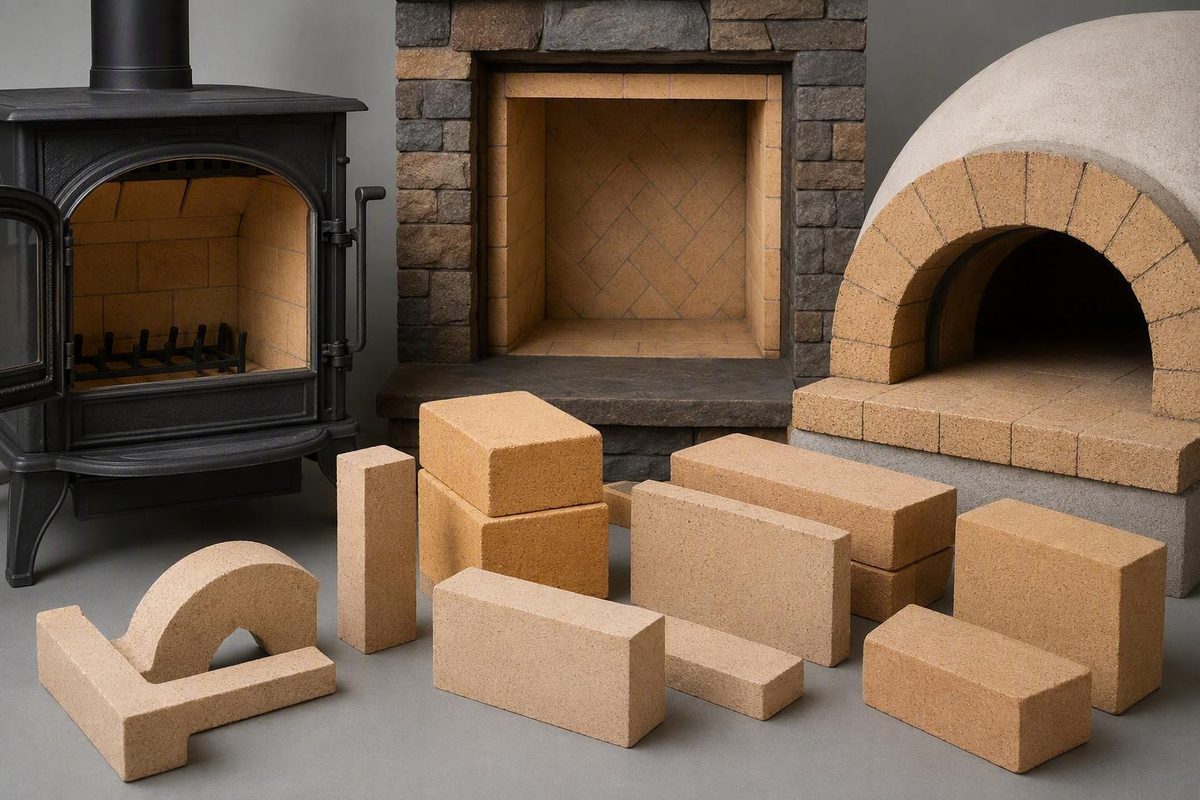
Fire brick should be selected by the work it performs—not simply by the highest temperature printed on a listing. A stove lining, fireplace firebox, pizza-oven floor, kiln wall, forge, or industrial furnace can expose refractory materials to different combinations of heat, load, abrasion, thermal cycling, and chemicals.
Begin by identifying the appliance or structure and the brick’s location within it. Then determine whether the material must protect a shell, store heat, limit heat flow, support weight, withstand wear, or fit a model-specific retaining system. Match those needs to the appliance instructions and technical documentation for the exact product.
Safety note: This article is a selection and documentation guide, not an installation approval or a determination that an appliance is safe to operate. Appliance listings, manufacturer instructions, project documents, and requirements imposed by the authority having jurisdiction take precedence. Mechanical Mentor’s terms for combustion-appliance guidance state that its material is for general reading and that combustion appliances may be subject to permits and inspections. If the appliance, lining design, or required replacement component cannot be positively identified, do not improvise the repair.
What fire brick is and what it does
Fire brick is a refractory ceramic block used to line high-temperature spaces such as fireboxes, fireplaces, furnaces, and kilns. Depending on the source, it may also be called firebrick, fireclay brick, or refractory brick. Suppliers do not always use those terms consistently, so the label alone does not establish suitability.
Common fireclay bricks are primarily based on silica and alumina, although their proportions and additional ingredients vary. Specialized refractory products may use other compositions for particular temperatures, atmospheres, chemical exposures, or wear conditions. A general overview of the terminology and material families appears in the fire-brick reference article.
In household equipment, a refractory lining commonly has two connected roles:
- Protecting surrounding components. The lining separates direct flame and hot fuel from steel, cast iron, or structural masonry.
- Influencing firebox thermal behavior. Depending on its density, thickness, and arrangement, the lining may store heat or limit heat flow toward surrounding components.
Those functions should not be confused. A dense brick with substantial thermal mass is not automatically the best insulation. A lightweight brick that limits heat flow effectively is not necessarily suitable for a floor or working surface exposed to loading, scraping, or impact.
Ordinary wall, paving, or concrete brick should not be assumed to be an equivalent substitute. Composition, manufacturing, dimensions, porosity, and behavior during repeated heating may differ from the refractory product specified for the system. In an appliance, follow the manufacturer’s replacement specification. In new masonry construction, follow the approved design and product documentation.
Dense fire brick, insulating firebrick, and other refractory products
The first major purchasing distinction is between dense or hard fire brick and insulating firebrick, commonly abbreviated IFB. These are different product families rather than interchangeable bricks at different price points.
Dense or hard fire brick
Dense brick is generally considered where the refractory must provide some combination of:
- Mechanical strength
- Resistance to routine contact or wear
- Thermal mass
- Structural stability at the hot face
- A durable working surface
Those characteristics can matter where fuel, tools, oven implements, kiln furniture, or ware repeatedly contacts the lining. The exact strength, abrasion resistance, porosity, and temperature capability still need to be established from the data sheet for the particular brick.
Dense material is not necessarily effective backup insulation. Its greater density may correspond with greater heat conduction than a porous insulating product, depending on the formulations being compared.
Insulating firebrick
IFB is porous and lightweight and is used primarily to limit heat flow. It is commonly easier to shape than dense brick but is also mechanically weaker. A high advertised temperature classification does not, by itself, make IFB appropriate for a load-bearing floor, abrasion-prone forge surface, or cooking floor.
Refractory catalogs commonly separate dense hard brick, insulating firebrick, and silicon-carbide products. When comparing them, verify the intended location in the lining rather than comparing only dimensions and maximum-temperature claims.
Specialized refractory brick
More specialized refractory products may contain higher proportions of alumina, mullite, silicon carbide, or zirconia. Manufacturers associate these compositions with demanding industrial conditions involving wear, corrosion, high-temperature strength, or particular operating atmospheres.
These products should not be generalized to residential fireplaces or ovens. Saint-Gobain’s comparison of refractory brick and general fire brick presents specialized compositions as application-specific materials. It does not establish that any one industrial refractory is appropriate for a household appliance or direct cooking surface.
“Industrial grade” is not a substitute for an intended-use statement.
Refractory panels
A refractory panel is not simply an oversized fire brick. Factory-built fireplaces may use molded panels designed for a particular firebox geometry, retaining system, installation sequence, and expansion arrangement.
Generic brick should not be represented as an equivalent replacement for an original panel unless the fireplace manufacturer expressly documents that substitution. Identify the fireplace make and model, locate the correct part information, and use the specified procedure. Specialty fireplace guidance similarly distinguishes individual masonry bricks from model-specific refractory panels.
Castable refractory
Castable refractory is mixed and formed into a monolithic shape rather than assembled from individual bricks.
Brick and castable should not be treated as equivalent without comparative technical data. An informal demonstration based on the surface cooling of one castable block and one brick cannot establish equal heat capacity, conductivity, durability, or thermal-shock resistance. Product-specific documentation is required.
Terminology crosswalk
| Term | What it usually means | What the term does not prove |
|---|---|---|
| Hard brick / dense fire brick | Dense refractory unit used where strength, wear resistance, or thermal mass may matter | That it is the best insulator or correct for every hot face |
| Insulating firebrick / IFB / soft brick | Lightweight, porous brick intended mainly to reduce heat flow | That it can carry load or withstand abrasion because its temperature rating is high |
| Refractory panel | Molded lining component, often specific to a factory-built fireplace | Interchangeability with generic masonry fire brick |
| Castable refractory | Refractory mixture cast or formed into a monolithic component | Performance equivalent to brick without comparative technical data |
| Refractory mortar | High-temperature jointing material for compatible refractory masonry | Suitability for every appliance, brick, or joint thickness |
| Fire cement | Heat-resistant compound with product-specific repair or jointing uses | That every cracked brick can be patched instead of replaced |
Choose by application, not by temperature rating alone
Application names on product listings are starting points, not approvals. Before comparing brands or prices:
- Identify the appliance or structure. Record the manufacturer, model, serial information, fuel, and whether the construction is site-built or factory-built.
- Identify the material’s location. A floor, sidewall, baffle, hot face, backup layer, or outer insulation may have a different job.
- Define that job. Determine whether the material is intended to provide strength, thermal mass, insulation, geometry, or shell protection.
- List the exposures to verify. These may include direct flame, sustained temperature, heating rate, repeated cycling, load, abrasion, ash, slag, gases, or other chemicals.
- Confirm dimensions and installation details. Check thickness, shape, joints, retainers, and required clearances or expansion spaces.
- Obtain documentation. Use the technical data sheet and appliance instructions rather than relying on a marketplace title.
The following table is a screening tool only. It identifies documentation questions; it does not prescribe a brick for a particular appliance.
Application selection table
| Application | Primary job to establish | Documentation to obtain | Questions to verify | Common selection error |
|---|---|---|---|---|
| Wood-stove lining | Protect the stove body and preserve the designed firebox | Stove manual, parts diagram, replacement specification | Exact material, thickness, layout, edge profile, and installation method? | Buying a same-size brick without matching the original material |
| Masonry fireplace | Protect structural masonry while preserving firebox geometry | Approved design, brick specification, mortar instructions | Brick type, joint material, joint thickness, and original dimensions? | Using ordinary mortar or changing the chamber geometry |
| Factory-built fireplace | Restore the manufacturer’s panel system | Rating-plate information, parts list, OEM procedure | Exact model, panel number, retainers, sequence, and required gaps? | Substituting generic brick or a “universal” panel |
| Pizza-oven floor | Provide the documented thermal and working surface | Oven design and brick technical data | Intended use, composition, flatness, wear characteristics, and cleaning requirements? | Choosing porous IFB solely for its temperature rating |
| Pizza-oven dome | Form the hot enclosure | Engineered oven plan and product instructions | Brick or castable specification, thickness, joints, and commissioning procedure? | Assuming castable and brick are interchangeable |
| Kiln | Provide the specified hot face or insulation | Kiln design, refractory data sheets, element or burner requirements | Atmosphere, load, cycling, chemistry, and material location? | Using one brick type throughout without design support |
| Forge | Provide the designed hot face or insulation | Forge design and refractory instructions | Burner exposure, floor wear, flux contact, and replaceable-lining details? | Leaving fragile insulation exposed to routine damage |
| Furnace or boiler | Form part of an engineered refractory lining | Equipment manual and refractory schedule | Service temperature, atmosphere, load, abrasion, anchoring, and chemistry? | Selecting from maximum temperature alone |
| Fire pit | Meet the project design and outdoor service requirements | Approved project documents and product instructions | Fuel, weather exposure, drainage, geometry, and local requirements? | Treating a retailer’s “fire pit” label as universal approval |
Wood stoves
For an existing wood stove, begin with replication. Match the original lining’s material, length, width, thickness, profile, and layout.
Do not infer the installation method from another stove. Some bricks are held by firebox geometry or retainers, while other components may use a specified bonding product. A commercial replacement guide illustrates that bonding methods can vary between clay and vermiculite products, which is why the stove’s own documentation must control; see the Vitcas wood-burner replacement guide.
Masonry and factory-built fireplaces
A site-built masonry fireplace may use individual refractory bricks and compatible refractory mortar. Preserve the documented firebox dimensions and joint arrangement rather than altering the chamber to accommodate whatever brick is available.
A factory-built fireplace is a different type of system. Locate its rating plate and identify the exact make and model. Obtain the designated panel, retainers if required, and installation procedure. Do not apply a generic masonry repair method to a molded panel unless the manufacturer directs it.
Pizza ovens
A pizza-oven floor may be exposed to loading, brushing, scraping, and repeated heating and cooling. Those conditions make working-surface durability, flatness, thermal behavior, and intended use relevant selection questions.
Cooking-surface suitability is a separate documentation issue. A seller’s statement that a brick is suitable for pizza ovens does not independently establish its composition or suitability for direct cooking-surface use. Ask for traceable product documentation. Avoid relying on reclaimed industrial brick when its original composition and service history cannot be established.
Kilns, forges, and furnaces
These applications cannot be selected from a household fire-brick rule of thumb. The appropriate refractory may depend on its exact position in the lining and on operating atmosphere, load, heating rate, abrasion, chemical contact, or burner exposure.
Where a design uses multiple refractory layers, each layer may have a different specification. Do not assume that a material selected for insulation can substitute for the working hot face—or that a durable hot-face brick will provide the required backup insulation.
Retailers advertise fire brick for kilns, forges, boilers, furnaces, ovens, and fire pits. Treat those advertised uses as reasons to investigate the product, not as approval for a specific project.
Grades, temperature ratings, and specifications that matter
Labels such as medium duty, high duty, and super duty appear in refractory catalogs. They should be checked against the exact manufacturer’s classification, applicable standard, and product data rather than treated as universal performance guarantees. Even a documented grade does not prove compatibility with a particular appliance.
Why maximum temperature is not enough
A headline temperature does not tell you:
- Whether the number is a classification limit or recommended service condition
- Whether exposure may be continuous or only intermittent
- Whether the rating applies under mechanical load
- What heating and cooling rates were considered
- How repeated cycling affects the product
- Whether a reducing or chemically aggressive atmosphere changes performance
- Which test method produced the figure
- Whether the brick is intended for the hot face or protected insulation
Marketplace titles have advertised fire-brick products at approximately 2,400°F to 3,000°F, but the search listings do not provide enough test information to establish application suitability. They also place residential fireclay, lightweight IFB, and generic stove-brick sets beside one another despite their different potential roles; see the marketplace fire-brick results.
Properties to keep separate
Do not use one property as shorthand for all refractory performance:
- Thermal mass concerns the heat a component absorbs and stores as its temperature changes.
-
Thermal conductivity concerns how readily heat moves through the material.
-
Strength may include resistance to crushing, bending, handling damage, or service load.
-
Abrasion resistance matters where fuel, tools, ware, or cleaning contacts the surface.
- Chemical compatibility concerns ash, flux, slag, metal, gases, and operating atmosphere.
- Thermal-shock resistance concerns response to rapid or repeated temperature changes.
A high temperature classification does not establish high strength, low conductivity, chemical compatibility, or resistance to thermal cycling.
Buyer’s documentation checklist
Before buying for a critical installation, request:
- The technical data sheet for the exact product
- Intended applications and stated limitations
- Refractory family or composition
- Density and porosity
- Service-temperature conditions
- Thermal conductivity over a stated temperature range
- Strength or abrasion data where relevant
- Atmosphere and chemical limitations
- Applicable test methods or standards
- Safety data sheet
- Cutting, jointing, drying, and commissioning instructions
- Written appliance compatibility when replacing a listed component
- Intended-use documentation for a cooking surface, where applicable
Superior Clay states that its fireplace firebrick must meet ASTM C 1261, but its webpage does not provide test results. That is a manufacturer-specific claim and should not be extended to unrelated products; see the company’s firebrick specification overview.
Star ratings, bestseller labels, retailer badges, and category names may describe transaction history or availability. They do not verify refractory chemistry, conductivity, strength, thermal-shock behavior, or compliance with a standard.
Fire-brick sizes, shapes, measuring, and quantity planning
Two dimensions recur in residential and general refractory listings:
- Full or straight brick: nominally 9 × 4.5 × 2.5 inches
- Split: nominally 9 × 4.5 × 1.25 inches
A refractory supplier’s catalog lists both sizes along with several duty grades and shaped units, but these dimensions are common rather than universal; see the hard fire-brick catalog.
Common shapes
- Straights: Rectangular general-purpose units.
- Splits: Thin straights used where a reduced lining thickness is specified.
- Soaps: Narrow units for locations where a full-width straight will not fit.
-
Arches: Tapered bricks with a modest difference between inner and outer thickness.
-
Specials: Skews, tiles, rotary-kiln shapes, and proprietary molded pieces.
Arches and wedges are available to help form curves, but the correct shape depends on the radius, course layout, and joint design. Their availability does not eliminate the need for a designed layout.
How to measure replacement brick
- Identify the appliance. Find the make, model, serial information, and manual.
- Document the intact layout. Photograph and sketch the rear, sides, floor, baffles, retainers, overlaps, and orientation.
- Select an intact sample. An eroded or fractured piece may no longer represent the original size.
- Measure all three dimensions. Record length, width, and thickness.
- Identify the material family. Determine whether the component is dense brick, lightweight IFB, board, or a molded panel.
- Record edge details. Bevels, rabbets, notches, tapers, grooves, and retainer slots may be essential.
- Count each distinct shape. Separate full bricks, splits, cut pieces, handed parts, and molded components.
- Compare the result with the parts diagram. It may reveal missing pieces or an incorrect earlier repair.
Nominal size does not prove interchangeability. Two products measuring 9 × 4.5 × 1.25 inches can differ in material, strength, tolerance, intended use, and installation requirements. An apparently exact-size substitute may also interfere with retainers or required spaces.
Estimating quantity
For a simple flat surface:
- Measure the gross lined area.
- Subtract doors, burner openings, flues, and intentionally unlined areas.
- Choose the required brick orientation.
- Determine the exposed face area of one brick in that orientation.
- Include joint width only where the documented design uses joints.
- Divide the net area by the effective coverage of one brick.
- Round up to whole units.
- Add a project-specific allowance for cuts, breakage, selection, and matching future spares.
In conceptual form:
brick count = net lined area ÷ effective face coverage per brick
Calculate separate walls and planes individually before totaling them. Curved surfaces should be laid out by course or circumference rather than estimated solely from flat area. Arches and domes require the actual radius and joint design.
There is no defensible universal waste percentage for every project. A rectangular stove using factory-size splits may require little cutting, while a curved oven or patterned firebox may require substantially more. Packaging and shipping damage can also affect the allowance.
For an irregular firebox, preserve the original coverage, orientation, and intentional spaces. Do not fill gaps with ash, sand, clay, cement, or another improvised material merely because that method was suggested for a different appliance.
What fire brick costs and how to compare delivered value
Fire-brick prices vary by type, grade, shape, quantity, seller, and freight. The following figures are captured retail observations, not current quotations or market averages.
The observed examples ranged from approximately $3.33 to $8.74 per brick:
- A six-pack was displayed at $34.49, or about $5.75 per brick.
- A 12-piece stove-brick set was displayed at $39.99, or about $3.33 per brick.
- Individual hard bricks were listed from $3.94 to $7.16, depending on grade and shape.
- A G-28 insulating brick was listed at $8.74.
The six-pack and 12-piece figures appeared in the marketplace results cited above. The hard-brick range appears in the refractory catalog cited in the sizes section, while the G-28 figure appeared in the insulating-brick retailer catalog cited earlier. Prices, stock, pack configurations, and delivery terms can change.
For another traceable snapshot, Home Depot displayed a six-pack of 9 × 4.5 × 1.25-inch Rutland bricks for $34.49 on its Rutland fire-brick product page.
These products are not necessarily comparable. A dense residential fireclay split, a higher-duty hard brick, and a lightweight IFB can share similar dimensions but serve different functions. The lowest unit price has little value if the product does not meet the project specification.
Delivered-cost worksheet
| Cost item | What to include |
|---|---|
| Required units | Whole-brick count for the documented layout |
| Cuts and spares | Project-specific extra units for cutting, breakage, and future matching |
| Shaped units | Arches, wedges, soaps, proprietary cuts, or OEM components |
| Jointing material | Only the specified refractory mortar, fire cement, or adhesive |
| Cutting consumables | Appropriate blades, wheels, or equipment rental |
| Protective measures | Dust controls and protective provisions identified by the safety data |
| Packing and breakage | Replacement risk, particularly for lightweight materials |
| Tax | Applicable sales or use tax |
| Shipping | Parcel charges, oversize fees, or freight |
| Handling and storage | Unloading, dry storage, and movement to the work area |
Where to buy
Local masonry, stove, or fireplace suppliers may be convenient for a small repair. The buyer can inspect dimensions and condition and may be able to purchase individual units.
Online packs may suit common stove splits, but pack size can force overbuying. Confirm that specifications and reviews apply to the exact variation offered.
Specialty refractory suppliers generally provide a wider selection of grades and shapes and may be better positioned to supply technical documentation.
Pallet orders may reduce the base price for a large project, but freight, unloading, breakage, and leftovers can change the economics substantially. One retailer displayed a 456-brick pallet for $3,449.99 plus shipping, illustrating why delivered cost matters; the figure is a historical listing observation rather than a current quote.
Do not rank refractory products by review score, retailer badge, or unit price alone. Compare documented function and total delivered project cost.
Installation choices: dry-stacked, mortared, bonded, or OEM-fitted
The appliance instructions, original design, component documentation, and product directions determine the installation method. There is no universal rule that all fire brick should be mortared—or that every lining should be installed dry.
Four distinct pathways
1. Dry-stacked stove linings
Some stove bricks are held by the firebox geometry, channels, or retainers. If the manual specifies dry installation, adding mortar could alter the designed fit or make later service difficult.
A forum discussion about an older Fisher stove describes a dry-installed, model-specific sequence. It should be treated only as an example of why the appliance model matters, not as instructions for other stoves.
2. Mortared masonry fireboxes
Site-built masonry fireboxes may use individual refractory bricks with a compatible refractory mortar. Brick orientation, joint design, geometry, and product-specific drying requirements must follow the project documents.
Ordinary Portland-cement mortar should not be presumed suitable for high-temperature refractory joints. Use only the jointing product specified for the brick and assembly.
3. Bonded boards or insulating products
Some refractory boards or lightweight components use a specified adhesive. Compatibility must be established from the component and adhesive instructions. General construction adhesive is not an equivalent substitute.
4. OEM-fitted refractory panels
Factory-built fireplace panels use the retaining method, sequence, orientation, and spaces specified for the model. They should not be installed as if they were conventional masonry bricks unless the manufacturer directs that method.
Conservative replacement workflow
Where the manufacturer permits owner replacement:
- Confirm the appliance identity and obtain its instructions.
- Allow the appliance and its contents to become completely cold.
- Review safety data for the existing and replacement materials, cutting method, and any bonding product.
- Follow the specified dust-control, protective-equipment, and cleanup measures.
- Document the existing arrangement before disassembly.
- Remove loose debris without damaging sound components.
- Inspect the shell, retainers, baffles, joints, and adjacent lining.
- Compare an intact original component with the replacement.
- Dry-fit the full layout before applying an authorized bonding product.
- Install by the documented method, preserving intended seating and spaces.
- Confirm that bricks, panels, retainers, baffles, and doors are secure and unobstructed.
- Follow the exact drying and commissioning instructions for the appliance and installed products.
This workflow does not establish that a particular repair is suitable for DIY work. If the manual does not authorize the procedure or the required information is unavailable, refer the work to the manufacturer, an authorized service provider, or an appropriately qualified professional.
Cutting fire brick
Insulating brick is commonly easier to shape because it is porous and soft. Dense brick may require suitable masonry-cutting equipment. The correct method depends on the material and manufacturer’s instructions.
Cutting can release dust. Consult the product safety data sheet for required exposure controls, eye and respiratory protection, and cleanup. Do not cut an unidentified used refractory until its composition and prior service can be established.
Drying and commissioning
Do not apply one internet curing schedule to every installation. Requirements vary among mortar, fire cement, adhesive, castable, brick, panel, and appliance designs.
Follow every applicable instruction. If the appliance and refractory-product directions appear inconsistent, stop and ask the manufacturers or an authorized service provider for clarification.
Cracks, crumbling, and the line between DIY and inspection
Visible marks do not all have the same significance. Assessment depends on the appliance type, component design, crack depth, stability, material loss, seating, and whether the protective lining remains complete.
The matrix below is a conservative screening guide, not a declaration that an appliance is safe to use. Manufacturer criteria control.
| Condition | What to establish | Conservative next step |
|---|---|---|
| Stable hairline surface crack | Whether the crack is permitted by the appliance criteria and whether the component remains stable | Monitor only if the manufacturer permits it |
| Small cosmetic chip | Whether coverage, seating, or retention is affected | Compare with manufacturer limits and watch for progression |
| Deep or through-fracture | Whether the component can separate, shift, or expose material behind it | Obtain model-specific replacement or repair guidance |
| Loose brick or panel | Why retention or seating has failed | Do not improvise continued operation; obtain the specified correction |
| Missing chunk | Whether protective coverage has been reduced | Obtain repair or replacement instructions |
| Crumbling or flaking | Whether the material is losing integrity | Replace or inspect as directed for the appliance |
| Poor seating or displacement | Whether the cause is debris, wrong dimensions, damaged retainers, or incorrect layout | Identify and correct the cause under approved instructions |
| Exposed stove body or structural masonry | Whether the lining is incomplete | Obtain appliance-specific repair guidance before further operation |
| Multiple failed components | Whether wider overheating, impact, age, or system damage is involved | Arrange a qualified inspection |
| Cracked factory-built panel | Whether the crack exceeds the manufacturer’s limits | Apply only the model-specific OEM criteria |
Available service guidance does not support replacing every brick solely because it has a stable hairline crack. It does identify large fractures, missing material, crumbling, poor seating, exposed stove-body gaps, multiple damaged bricks, warped fireboxes, indoor smoke, and poor draft as reasons to seek repair guidance or inspection; see the wood-stove damage and replacement guide. The stove manufacturer’s instructions remain controlling.
Repair versus replacement
For individually installed masonry firebrick, a manufacturer or repair procedure may permit compatible fire cement for a limited crack. That is different from filling a deeply fractured, unstable, or materially incomplete brick. Repointing a deteriorated mortar joint is also different from bonding a failed unit.
Do not infer that every fire cement can repair every crack. Product compatibility, surface preparation, movement, crack depth, drying, and service conditions matter. Earthcore’s general firebrick repair procedure applies to individually installed masonry brick and expressly defers factory-built panel work to the fireplace manufacturer.
For a factory-built fireplace, use the manufacturer’s panel criteria and replacement procedure. Generic refractory mortar may not be part of the designed installation. If the model or procedure cannot be found, obtain qualified assistance rather than concealing the damage with a generic patch.
Stop-work and inspection triggers
Stop the repair process and obtain manufacturer or qualified professional guidance when:
- The appliance make, model, or lining design is uncertain
- The required parts diagram or procedure cannot be obtained
- Multiple components are loose, missing, deeply fractured, or crumbling
- Damage is widespread rather than isolated
- Firebox metal appears warped, cracked, exposed, or heavily deteriorated
- Retainers, baffles, supports, or panel channels are damaged
- Smoke enters the room
- Draft has changed or remains poor
- Chimney, connector, or venting damage is suspected
- Required OEM components are unavailable
- A previous repair changed the geometry or used unidentified materials
These are conservative referral triggers, not a remote diagnosis. General online guidance cannot determine that a particular stove, fireplace, kiln, forge, or furnace is safe to operate.
The practical purchasing rule is straightforward: identify the system, define the material’s job, separate thermal-mass and mechanical requirements from insulation requirements, and verify the exact product against manufacturer documentation. Match original dimensions and material when replacing appliance components, calculate delivered rather than unit cost, and do not proceed when the design or approved method is uncertain.
Can I use regular brick instead of fire brick?
Do not assume that you can. Ordinary masonry, paving, or concrete brick may differ in composition, firing, porosity, dimensions, and response to repeated heating.
For an appliance, use the refractory material specified by its manufacturer. For a masonry system, follow the approved design and product specifications. A same-size ordinary brick is not an equivalent replacement merely because it fits.
Is insulating firebrick better than dense fire brick?
Neither is universally better. Dense brick is generally considered where mechanical strength, working-surface durability, or thermal mass matters. IFB is generally used where limiting heat flow is the primary job and the material is adequately protected.
The correct choice depends on the location and documented design. Some systems use different materials in different parts of the lining.
Does a cracked fire brick always need to be replaced?
No. A stable hairline surface crack may not require immediate replacement if the appliance manufacturer permits it and the component remains seated and complete.
Deep fractures, loose pieces, missing material, crumbling, displacement, or exposed backing require model-specific repair guidance or inspection. Crack appearance alone is not enough to determine safe operation.
Can generic fire brick replace a factory-built fireplace refractory panel?
Not unless the fireplace manufacturer expressly documents that substitution. Factory-built panels are commonly made for a particular model, geometry, retaining arrangement, and installation sequence.
Locate the rating plate, identify the exact model, and obtain the specified panel and procedure. Do not improvise a brick-and-mortar substitute.
Is fire brick safe for a pizza-oven cooking floor?
Some fire bricks are marketed for pizza ovens, but that claim alone does not establish suitability for a direct cooking surface. Verify the product’s intended use, composition, surface characteristics, and relevant documentation.
A dense refractory brick may be considered where the documented oven design calls for thermal mass and a durable working surface. Do not select a cooking-floor brick solely by its advertised maximum temperature, and do not use reclaimed industrial refractory with an unknown composition or service history.