
Which Chimney Cover Do You Need: Cap, Chase Cover or Crown?
Identify a chimney cap, chase cover or crown, then check vent compatibility, leak location and measurements before ordering a replacement.
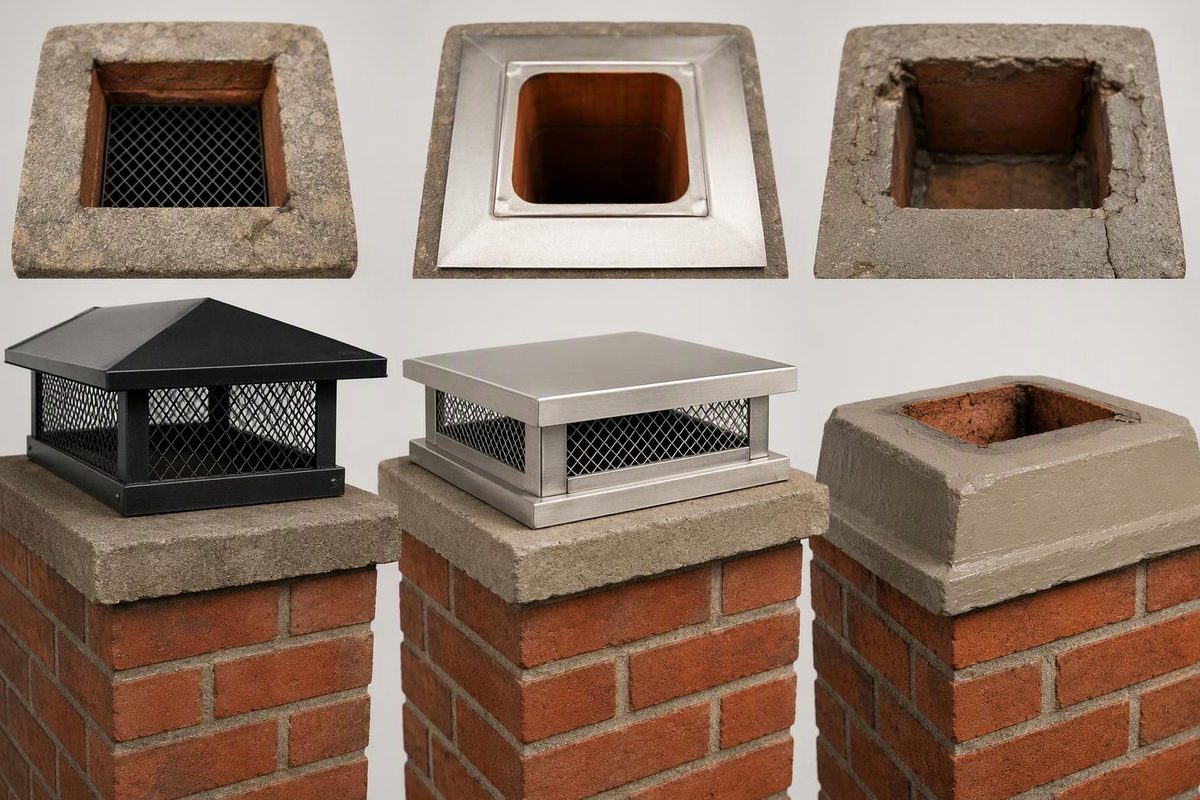
A chimney cover can mean the rain cap over a flue, the metal cover over a framed chimney chase, or the crown at the top of a masonry chimney. These parts protect different areas. Replacing one will not necessarily repair a leak through another.
Start with two questions: What needs protection—the flue opening or the structure around it? And what appliance and vent system are underneath? A cover must shed water without obstructing the required exhaust path.
Identify the part
| What you see | Usual name | What it protects |
|---|---|---|
| A raised metal hood above one or more flue outlets, often with screened sides | Chimney cap or rain cap | The flue openings, while allowing exhaust to escape |
| A broad metal sheet covering a framed, often sided enclosure, with chimney pipe passing through it | Chimney chase cover | The top of the enclosure around the chimney pipe |
| A sloped concrete or masonry surface around projecting flue liners on a brick chimney | Chimney crown | The top of the masonry chimney |
Retailers sometimes use “cover” and “cap” loosely. Rockford Chimney Supply’s terminology guide distinguishes the flue cap from the cover around it. Order by the component’s function, mounting arrangement and dimensions—not the product name alone.
A multi-flue cap may have a large hood spanning much of a masonry chimney, but that does not make it a replacement for a damaged crown.
Match the cover to the vent system
For a masonry chimney: establish whether the outlet is a clay flue tile, a metal liner termination or another assembly. Record the mounting surface, flue dimensions, number of outlets and height of each outlet above the crown. A cap attaching to a clay tile and one attaching to a liner are not interchangeable merely because their hoods look similar. Use the chimney cap replacement guide for the detailed fit and mesh checks.
For factory-built metal chimney: identify the manufacturer, product line and diameter before selecting a cap. Physical fit alone does not establish compatibility. DuraVent’s 5–8-inch DuraTech instructions, for example, require authorized system parts and prohibit mixing products or improvising components. That is a requirement for that system—not approval to use a DuraTech cap on another brand.
For a chase cover: the broad sheet and the pipe termination must work together. Do not assume every gap around the pipe should be caulked shut. The DuraTech chase-top instructions specify air gaps at the chase-top flashing and beneath the storm collar, plus clearance between the cap and chase top. Other systems need their own details. Use the chase-cover measuring and specification guide once the chimney system is identified.
Stop before ordering if the system is unknown. Have a chimney professional identify it and confirm the approved termination. Do not substitute a generic screened masonry cap for a gas or pellet vent terminal without the system manufacturer’s approval. For example, PelletVent Pro’s instructions require authorized parts and prohibit mixing with other manufacturers’ products or improvised solutions.
If the problem is water, locate the entry point
A rain cap addresses water entering the flue opening. It does not repair cracked masonry, failed roof flashing or a leaking chase cover.
The Chimney Safety Institute of America’s water-damage guidance treats caps, crowns, flashing and masonry water penetration as separate maintenance issues. Ask for an inspection of the whole exposed assembly rather than a quote for “a cover” alone.
From the ground, binoculars or zoomed photographs can help document a missing hood, rust streaks, an uneven metal cover or visible masonry damage. These are reasons to investigate, not proof of where water enters. Do not climb onto the roof just to obtain ordering measurements.
What to put in a replacement quote
Ask the contractor or supplier to specify:
- The exact component being replaced and the appliance it serves.
- The vent manufacturer and product line, where applicable.
- Mounting dimensions, attachment method and material.
- Required exhaust clearance and any chase air gaps.
- Separate crown, flashing or structural repairs.
- Access for future inspection and cleaning.
If you mean a solid cover for an unused chimney, treat that as a different project. Have a chimney professional verify every connection before closing any outlet; an unused fireplace does not establish that the entire chimney is abandoned. The abandoned masonry chimney guide covers the options after use and condition are confirmed.