
A Vent Cap Must Match the Appliance and Vent System
Identify a vent cap by appliance, pipe system, size and termination type before replacing it. Learn what to inspect and when to stop using the appliance.
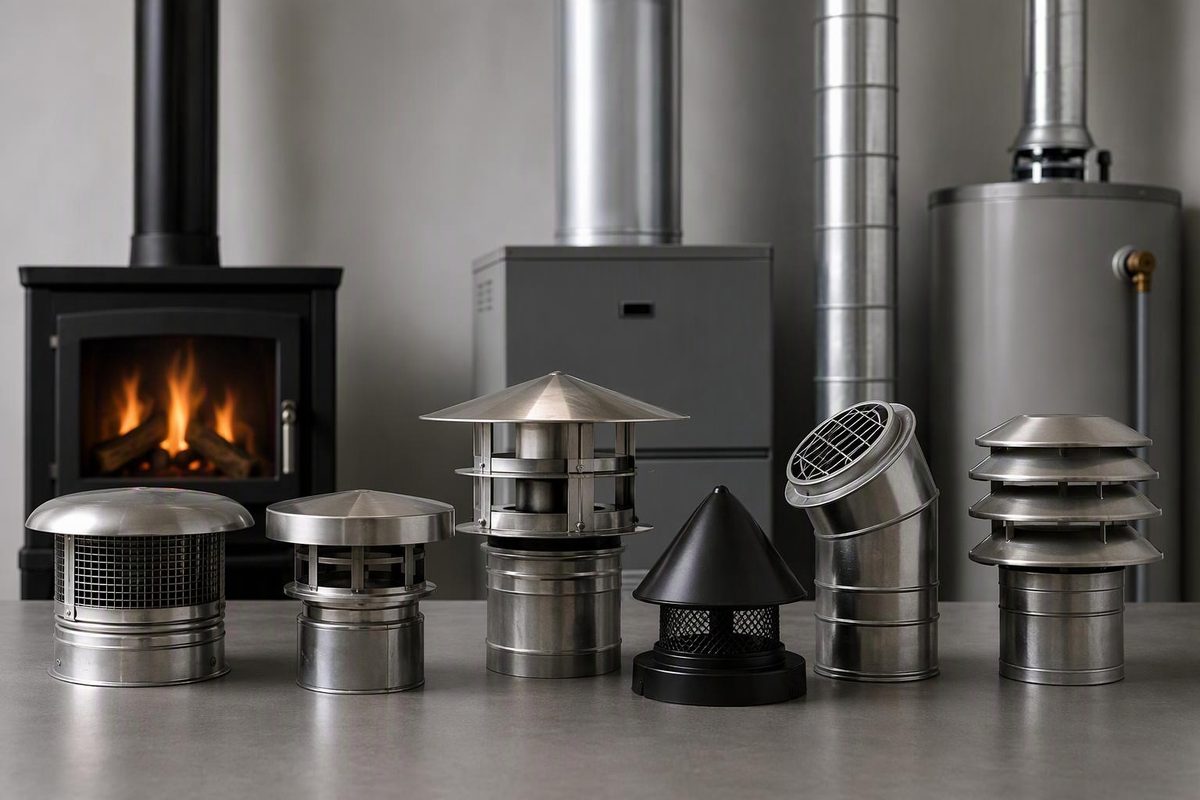
“Vent cap” is a broad name for the terminal fitting at the outdoor end of a vent. It is not a universal rain cover. Depending on the system, the termination may discharge combustion gases, admit combustion air, resist wind and rain, exclude animals, or open under airflow. Its shape, internal passages and attachment method are part of how the vent works.
Do not buy a replacement from diameter and appearance alone. First identify the appliance, vent type, manufacturer and product line. A cap made for a wood-burning chimney, Type B gas vent, direct-vent fireplace, pellet vent or dryer duct is not interchangeable with the others.
Identify which vent the cap serves
Trace the pipe to its appliance where that can be done without opening walls or disconnecting anything. Then look for labels on the appliance, exposed pipe, support box or existing termination.
| What the vent serves | What its cap must do | What to match |
|---|---|---|
| Wood stove or wood-burning fireplace | Terminate a high-temperature chimney while limiting entry of rain, debris and animals | Listed chimney brand and series, inside diameter, cap attachment and any approved screen |
| Natural-draft furnace, boiler or water heater | Preserve draft and discharge combustion products above the roof | Type B or other specified vent system, manufacturer, nominal size and listed cap |
| Direct-vent gas fireplace or stove | Keep separate exhaust and combustion-air paths functioning | Exact appliance-approved vent family, coaxial or co-linear layout, size and horizontal or vertical terminal |
| Pellet stove | Discharge mechanically driven exhaust and shed precipitation | Listed pellet-vent family, diameter, orientation and appliance-approved configuration |
| Condensing furnace or water heater | Terminate exhaust and, often, a separate or concentric intake | Exact appliance manual, approved pipe material and terminal arrangement |
| Clothes dryer | Discharge moist, lint-bearing air and close when idle | Full-size outlet and freely moving backdraft damper; no screen where the cited IRC rule applies |
This distinction matters most with direct vent. A coaxial direct-vent system uses its outer passage to bring combustion air toward the appliance and its inner passage to exhaust flue gases. The termination is therefore a functional two-path fitting, not a decorative cover. DuraVent directs installers to confirm that the vent system is approved for the specific appliance and to select a horizontal cap according to that appliance’s instructions (DuraVent DirectVent Pro catalog). See why gas-fireplace venting depends on the appliance design.
Match the cap to the listed system
Use this order of authority:
- Appliance rating plate and installation manual. Record the model and serial number, then find the manual for that exact model.
- Vent-system markings. Record the manufacturer, product family and nominal diameter from accessible labels.
- Cap instructions and listing. Confirm the proposed part is an approved termination for both the appliance and vent system.
- Locally adopted code and permit requirements. A current model code is useful context, but your jurisdiction may use another edition or amendments.
The 2024 International Fuel Gas Code says gas vents are to be sized, installed and terminated according to both the vent and appliance manufacturers’ instructions. It also requires a Type B or L gas vent through a roof to end in a listed cap or listed roof assembly (2024 IFGC, Sections 502.5 and 503.6.7).
Do not assume a cap is compatible because it slips over the pipe. Factory-built chimney manuals can require authorized components throughout the listed system and specifically prohibit mixing parts or improvising substitutes (DuraVent DuraPlus instructions). A masonry flue may accept a separately attached cap, but the flue dimensions, mounting surface, fuel and open exhaust area still have to be verified. For that case, use the chimney-cap mounting guide.
Nominal size is not always outside diameter
Measure only after identifying the pipe construction. Double-wall pipe is commonly sold by its inside diameter, so its outside measurement is larger. For example, DuraVent identifies its 3- through 8-inch Type B vent by inside diameter and notes that the outside diameter is approximately 1/2 inch larger (DuraVent Type B catalog). Ordering a nominal 4-inch cap because the outside of an unknown pipe measures about 4 inches can therefore produce the wrong part.
Vertical and horizontal caps are different
Orientation is part of the specification. A vertical roof cap cannot automatically substitute for a sidewall terminal, even within one product family.
For one listed pellet-vent system, the manufacturer requires a vertical termination cap at the roof but a horizontal cap at a sidewall. Its instructions say the horizontal cap must point generally downward to keep rain and snow out, and expressly prohibit placing the vertical cap beside a vertical wall (DuraVent PelletVent Pro instructions). The appliance manual may also impose minimum rise, maximum run and clearances from doors, windows, air inlets, grade and nearby objects.
A dryer termination follows a different rule set. The 2024 IRC model code calls for a backdraft damper, prohibits a screen at the outlet and requires an unobstructed passage with at least 12.5 square inches of open area (2024 IRC, Section M1502.3). A screened “pest-proof” cover can collect lint and is not a suitable substitute where that provision applies.
Inspect the whole termination, not just the cap
From the ground or another safe location, look for:
- a missing, tilted or visibly loose cap;
- crushed openings, corrosion or separated seams;
- nests, leaves, lint, soot, snow or ice restricting the outlet;
- a screen or louver packed with deposits;
- staining that suggests leakage;
- a cap buried by snow or crowded by new construction, vegetation or stored objects;
- damaged flashing or a separated storm collar at a roof penetration.
The cap, storm collar and flashing perform different jobs. On a typical roof termination, the cap ends the vent, the storm collar seals around the pipe above the flashing, and the flashing manages the roof penetration. Replacing a cap will not repair failed flashing.
Cold-weather blockage deserves particular attention. Selkirk’s Type B instructions warn that bird screens can become blocked by freezing moisture and tell owners to check the rain cap for icing in low temperatures (Selkirk Type B installation instructions). If a cap repeatedly clogs, treat that as a venting or operating problem rather than repeatedly clearing the symptom. Blocked-vent appearance and operating clues can help with the first assessment.
Stop using the appliance when exhaust may not be leaving safely
Turn off a fuel-burning appliance and arrange qualified inspection if the cap or vent is blocked, disconnected or collapsed; if damage could obstruct or leak exhaust; if exhaust or soot is entering the building; or if operation changes after icing, nesting or storm damage. Do not climb onto a wet, icy or steep roof to investigate.
If a carbon-monoxide alarm sounds, do not look for the source. Move everyone outside to fresh air, call emergency services or the fire department, account for every occupant, and do not re-enter until responders give permission. Headache, dizziness, nausea, fatigue and shortness of breath can also indicate CO exposure; anyone experiencing symptoms should get outside and seek prompt medical help. Do not restart a malfunctioning appliance until trained personnel have serviced it (CPSC carbon-monoxide questions and answers).
A replacement cap is correctly specified only when you can write down all five items: appliance, vent type, vent manufacturer/product line, nominal size, and vertical or horizontal termination. If any one remains unknown, remove nothing and have the system identified first.