
What a Chimney Crack Is Telling You—and What to Do Next
Crack location, leaning, loose masonry, water and venting symptoms help determine urgency—and whether patching, repointing or rebuilding fits.
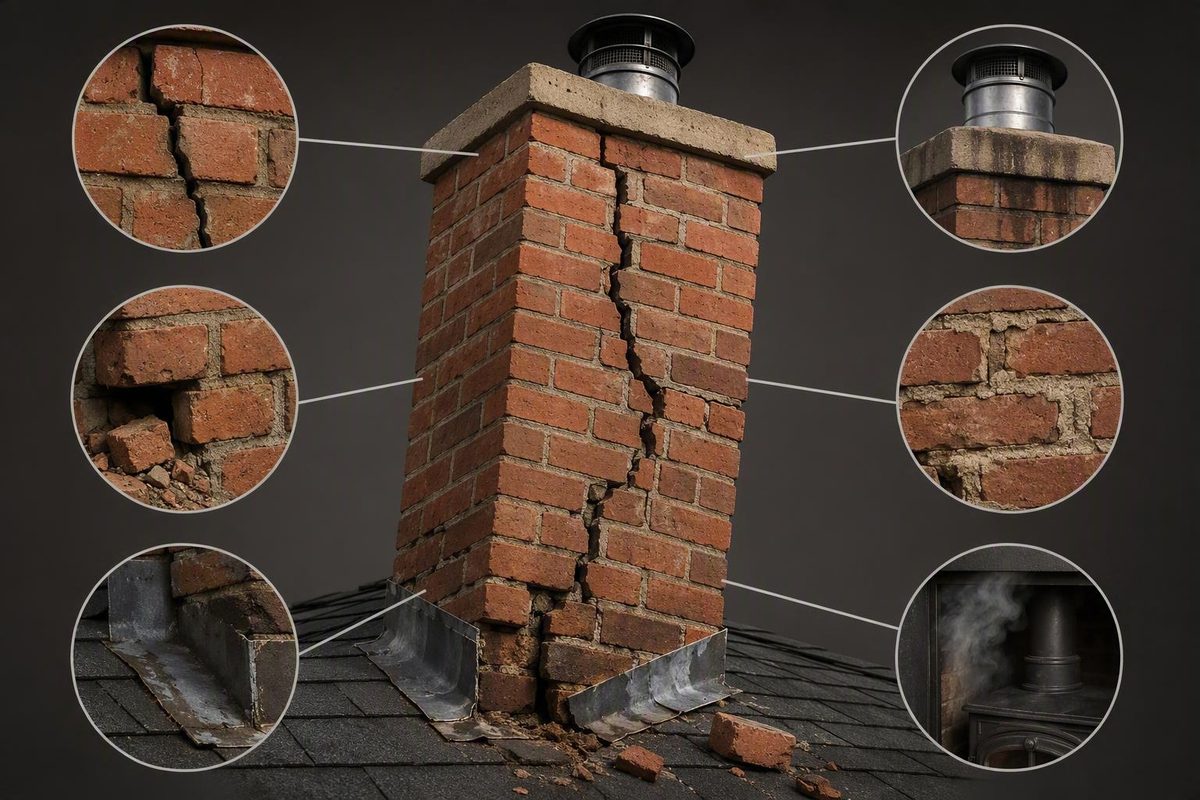
A cracked chimney is a warning sign, not a diagnosis. A visible line in a crown or mortar joint does not automatically mean the chimney is about to fail. It also cannot establish that the structure, concealed flue liner, or connected appliance is safe.
The useful questions are:
- Where is the crack?
- Does it cross mortar, brick, an interior firebox, or a flue liner?
- Is the chimney leaning, separating, shedding masonry, or admitting water?
- Has the defect changed?
- Are there smoke, draft, soot, odor, or carbon-monoxide-alarm symptoms?
Those answers help determine whether the next step is documentation, routine inspection, prompt structural evaluation, or emergency action. They also influence whether the eventual remedy is crown repair, repointing, brick replacement, flashing work, relining, partial rebuilding, or broader structural intervention.
First, decide how urgently the chimney needs attention
Every new or changing crack merits closer assessment, but not every crack has the same urgency. An isolated surface defect without movement or appliance symptoms belongs in a different category from a leaning stack, falling masonry, or uncontrolled smoke entering the home.
Local requirements come first
Follow the building and fire codes adopted in your jurisdiction, applicable permit and inspection requirements, and the instructions and listings for the appliance, liner, and venting products. The International Residential Code contains provisions for masonry chimneys and fireplaces, but the version adopted locally and the requirements for the specific appliance or system determine what applies to a particular home (International Residential Code, Chapter 10).
Four-level cracked-chimney triage
| Response level | Typical observations | What to do |
|---|---|---|
| 1. Document from a safe location | An old defect already evaluated as stable, with no apparent change, loose material, leakage, movement, or appliance symptoms | Take dated photographs and notes. Follow the maintenance or reinspection plan previously provided. Do not infer safety merely because the crack looks small. |
| 2. Arrange a routine professional assessment | An isolated crown crack, recessed mortar, limited surface flaking, efflorescence, or a newly noticed crack without visible movement or venting symptoms | Schedule an assessment of the relevant masonry and venting components. Avoid covering the defect before its location and likely cause are understood. |
| 3. Obtain prompt structural evaluation | A visible lean, separation from the house, loose masonry, apparent movement, substantial stair-step cracking, or a crack continuing through brick faces | Stay clear of loose material and the area beneath it. Obtain prompt professional evaluation. A structural engineer or foundation specialist may be appropriate when movement or support is in question; contractor field guidance likewise treats leaning, separation, and major through-masonry cracking as structural rather than cosmetic concerns (A-Z Construction). |
| 4. Take emergency action | A suspected active chimney fire, a carbon-monoxide alarm or suspected exposure, uncontrolled smoke entering occupied rooms, or falling masonry creating an immediate danger | Leave the affected area or building as appropriate and contact emergency services. Do not resume appliance use until the system has been professionally evaluated. |
Smoke entry needs context. **** A prior or intermittent drafting symptom that is no longer occurring still requires the appliance to remain off and the system to receive prompt evaluation, but it is not automatically equivalent to an active fire.
Stop using the connected fireplace, stove, furnace, or boiler when cracking appears with:
- Smoke entering the room
- Poor draft
- Unusual soot
- Persistent venting odors
- A carbon-monoxide alarm
- Suspected flue-liner damage
- Flue-tile fragments
- Evidence or suspicion of a chimney fire
These symptoms do not prove that the exterior crack caused the venting problem. Together, however, they are reasons to stop operation rather than continue testing the appliance.
Carbon monoxide is colorless and odorless. A smoky, acrid, or persistent venting odor can indicate a combustion or venting defect, but smell cannot identify carbon monoxide. For a carbon-monoxide alarm, suspected active exposure, or suspected active chimney fire, leave as appropriate and call emergency services. Do not resume appliance use until the source and affected system have been evaluated (Delta Chimneys).
A crack without appliance symptoms still cannot be declared safe from a photograph. Exterior masonry, concealed liner components, and the connected appliance are related but distinct parts of the system. A surface defect may be localized, while a modest-looking exterior crack can coexist with damage that is not visible from the ground.
Locate the crack before trying to interpret it
“Cracked chimney” can describe defects in components that perform very different jobs. Identify the affected component before choosing a sealant or asking for a repair price.
Cap
The chimney cap is installed over one or more flue openings. Depending on its design, it can reduce direct rain entry and discourage leaves or animals from entering.
A cap does not repair:
- A cracked crown
- Failed roof flashing
- Broken brick
- Unstable masonry
- A damaged flue liner
A missing or damaged cap may contribute to water or debris entry, but it should not become a catch-all explanation for every stain or masonry crack.
Crown
The crown is the slab or top covering around the flue opening on many masonry chimneys. Its purpose is to shed water away from the flue and masonry. A properly configured crown slopes to drain and uses an overhang or drip detail to help runoff fall clear of the chimney walls (The Chimney Guys).
A hairline crown crack principally raises questions about water entry and the crown’s overall condition:
- Is the crown still solid?
- Does it slope and shed water?
- Is it separating from the flue?
- Is the material crumbling beyond the visible crack?
- Are there related moisture signs below?
Those findings matter more than the word “hairline” by itself.
Exterior brick or stone
A crack through a brick face is different from erosion confined to the joint around it. Isolated broken, loose, or spalled masonry units may be candidates for selective replacement if the surrounding chimney remains sound.
A long crack passing through several units—especially with displacement, separation, or visible change—calls for a broader assessment. Filling the line with mortar does not reconnect fractured bricks or correct movement beneath them.
Stone chimneys require the same component-based reasoning, although stone type, bedding, joint profile, and compatible repair materials may differ from those used for brick.
Mortar joints
Mortar fills the joints between masonry units. Missing, recessed, cracked, or crumbling joints may be candidates for repointing: removing deteriorated mortar to an appropriate depth and installing compatible replacement mortar.
Repointing is not a generic answer to every chimney crack. It does not:
- Mend a brick split in two
- Stabilize a moving chimney
- Repair a flue liner
- Stop a flashing leak
- Correct an inadequate footing
It is a joint repair, and it works only when failed joints are the problem being addressed.
Roof flashing
Flashing is the metal detailing that seals the roof-to-chimney junction. A ceiling stain near a chimney may originate at the flashing, but it can also result from a crown, cap, open mortar joint, porous masonry, or another roof defect.
The stain identifies an area of concern, not necessarily the point where water entered.
Firebox
The firebox contains the fire in a masonry fireplace. Cracks in refractory joints, firebrick, or the firebox lining are interior defects and should not be confused with an exterior mortar crack.
Their significance depends on depth, displacement, surrounding condition, and fireplace design. A firebox defect also does not reveal the condition of the flue above it.
Flue liner
The flue liner forms the internal passage intended to contain and convey combustion products. Clay flue tiles can crack, shift, or deteriorate independently of the exterior brick.
Shaling means thin pieces or slices of damaged flue tile have accumulated below, often in the firebox or cleanout. Finding possible flue-tile fragments is a reason to stop using the connected appliance until the liner has been evaluated. Exterior appearance cannot establish that concealed liner sections are intact.
A component-based inspection therefore considers the cap, crown, masonry, flashing, firebox, smoke chamber, and liner separately rather than treating “the chimney” as one uniform object (Woodland Direct).
Chimney base, footing, and supporting structure
Cracking at the base, separation from the building, or a visible lean may involve support below the exposed stack. Possible contributors include footing movement, changing soil conditions, drainage, erosion, or movement in adjacent construction.
Surface patching cannot correct an active support problem.
The organizing principle is simple: different components perform different jobs. One generic tube of sealant cannot repair a crown, mortar joint, fractured brick, roof flashing, firebox, flue liner, and foundation.
Read the crack pattern and the surrounding warning signs
A crack is most informative when considered as part of a pattern. Direction, location, length, progression, displacement, and adjacent damage generally matter more than an unsupported universal width cutoff.
Compare patterns rather than relying on one measurement
- Isolated hairline crown crack: This may be limited to the water-shedding slab, but the crown’s soundness, slope, separation, and moisture effects still need to be checked.
- Crack confined to mortar: This may reflect localized joint deterioration, water exposure, or movement. Check whether nearby joints are also recessed or missing.
- Vertical crack through brick faces: The masonry units themselves have fractured. Stress or movement may be involved, so mortar-only patching is not an adequate diagnosis.
- Stair-step crack across several courses: This can indicate differential movement or settlement. It becomes more concerning when substantial, changing, displaced, or accompanied by separation.
- Gap between the chimney and house: This indicates relative movement somewhere in the assembly and warrants prompt evaluation.
- Random surface checking: This may be superficial in some materials, but that cannot be assumed without identifying the cracked material and checking for water entry or movement.
Some contractors use crack widths or percentages of spalled brick as internal proposal guidelines. Those may describe a company’s field practice, but they are not universal safety standards, code limits, or automatic rebuild rules.
Do not treat “credit-card width,” a particular fraction of an inch, or a stated percentage of damaged brick as a substitute for evaluating:
- Whether the crack is progressing
- Whether the sides are displaced
- How deeply the masonry is damaged
- Whether the chimney is leaning or separating
- Whether the liner is damaged
- Whether the footing and support are stable
Look for moisture clues
Spalling means brick faces are flaking, chipping, peeling, popping off, or breaking away. Moisture exposure can contribute, and in climates where wet masonry repeatedly freezes, freeze-thaw cycling can worsen the damage. Significance depends on how deep and widespread the material loss is and whether masonry units are loose.
Efflorescence is the white mineral deposit left when moisture moves through masonry, dissolves salts, and evaporates at the surface. It demonstrates moisture movement, but it does not identify where the water entered or prove that the chimney is structurally unsound.
Washing efflorescence away may change the appearance without correcting the moisture source.
Other associated clues include:
- Missing, cracked, or deeply recessed mortar
- Loose masonry or fragments on the roof or ground
- Rust at a damper, firebox, cleanout door, or other metal component
- Brown or dark staining on nearby ceilings and walls
- Damp or musty conditions after rain
- Crown cracking, crumbling, or poor water shedding
- Gaps or corrosion near flashing
- Flue-tile fragments in the firebox or cleanout
- Repairs repeatedly failing along the same line
Several defects together may point toward a broader moisture or movement problem. A crown crack, efflorescence, recessed joints, and spalling create a more coherent moisture pattern than any one symptom alone. A lean, stair-step crack, and separation strengthen the case for a movement investigation.
Even then, the pattern establishes a line of inquiry—not a remote diagnosis.
Understand why chimneys crack
Cracks frequently have more than one contributing cause. Movement or poor construction may create the initial opening; water then enters and accelerates deterioration.
Water and freeze-thaw cycling
Brick, mortar, and concrete can absorb water. Water entering porous masonry or an existing crack can contribute to deterioration through repeated wetting. Where saturated masonry repeatedly freezes, the water’s expansion can enlarge defects and contribute to mortar failure and spalling.
This mechanism is particularly relevant in climates with repeated saturation and freezing. It should not be presented as the cause of most chimney cracks everywhere. Home-inspection training guidance identifies moisture and freezing alongside soil, drainage, vegetation, and fire as possible contributors rather than a complete diagnosis for every crack (Inspection Certification Associates).
Possible water-entry points include:
- A cracked, flat, deteriorated, or poorly shedding crown
- Missing, damaged, or unsuitable cap components
- Failed roof flashing or surrounding roofing
- Open mortar joints
- Cracked or already spalled masonry
- Porous masonry exposed to repeated wetting
- Transitions around flues, rooflines, or attached construction
A well-configured crown directs water away from the flue and chimney walls. Overhang and drip protection help runoff fall clear rather than travel down the masonry. That is why filling a vertical crack while ignoring a failed crown can lead to recurrence.
Settlement and inadequate support
A masonry chimney places concentrated weight on its support. Differential settlement, inadequate footing, unstable or poorly drained soil, erosion, or changes near the foundation can allow one portion to move relative to another.
The resulting crack may:
- Follow mortar joints
- Pass through brick or stone
- Open a gap between the chimney and house
- Produce visible displacement or leaning
Distinguishing an old, stable condition from continuing structural distress requires a site-specific evaluation that may need to include the footing and adjacent building—not only the visible stack.
Drainage, roots, and vegetation
Poor grading, concentrated roof runoff, leaking gutters, or changes in groundwater can destabilize supporting soil or keep masonry wet.
Tree roots may alter nearby soil or exert pressure around foundations. Vines can enter weak joints and retain moisture against masonry. Removing vegetation may be part of the response, but it does not restore deteriorated joints or correct movement that has already occurred.
Heat and chimney-fire damage
Chimneys experience heating and cooling during operation. Thermal stress, material incompatibility, construction defects, unusually intense firing, or abrupt temperature changes may contribute to cracking.
If an active chimney fire is suspected, leave as appropriate and call emergency services. If there is evidence that a chimney fire occurred previously, keep the appliance out of use and arrange evaluation before relighting.
An exterior photograph cannot clear the concealed flue for operation.
Severe events and construction defects
Other possible contributors include:
- High wind or impact from falling limbs
- Lightning
- Seismic activity
- Poor-quality or unsuitable materials
- Improper masonry bonding or detailing
- Inadequate crown, flashing, or drainage design
- An incompatible prior repair
- Corrosion or expansion of embedded metal
- Movement where the chimney meets another structure
A patch can fail even if it was neatly installed. Recurring cracking often indicates that moisture entry, movement, a failed construction detail, or material incompatibility was not corrected.
The damage can also be cumulative: settlement opens a crack, rain enters, freezing enlarges it, and a hard or incompatible patch shifts stress into adjacent masonry.
Document what you can see without creating a roof hazard
Good documentation can help a professional distinguish an isolated observation from a changing condition. It should never require unsafe access or standing beneath unstable masonry.
Ground-level documentation checklist
Record:
- The date first noticed
- Exact location: crown, upper stack, roofline, wall, base, firebox, or another area
- Crack direction: horizontal, vertical, diagonal, stair-step, or irregular
- Approximate visible length and width
- Whether it crosses mortar, brick or stone, or both
- Any apparent offset between the two sides
- Nearby flaking, bulging, missing mortar, or loose material
- White deposits, dark staining, dampness, or interior ceiling marks
- Rust or moisture in accessible fireplace areas
- Tile or masonry fragments found below
- Recent storms, lightning, earthquakes, impact, drainage work, or suspected chimney-fire events
- Appliance symptoms such as smoke, poor draft, soot, or unusual odor
Take a dated overview photograph showing the defect’s position on the chimney and a closer image showing its pattern. A ruler or familiar object can provide scale only if it can be positioned without climbing, leaning from a window, standing beneath loose masonry, or otherwise increasing risk.
From accessible interior areas, look without dismantling the system. Note:
- Smoke staining
- Dampness or water stains
- Rust
- Loose material
- Visible firebox damage
- Possible flue-tile fragments
Do not remove appliance connectors, liners, dampers, panels, or other installed components simply to investigate a crack.
Photographs can help establish whether a visible feature changes over time. They are not a reason to postpone prompt evaluation when there is leaning, separation, falling masonry, active leakage, appliance symptoms, or suspected liner damage.
Monitoring should be used only when an evaluator has determined that the condition is suitable for monitoring and has provided a meaningful comparison plan.
Avoid:
- Walking on a steep, wet, icy, fragile, or unfamiliar roof
- Leaning a ladder against cracked or unstable masonry
- Standing or sitting on the chimney
- Pulling on a cap, flashing, loose brick, or crown fragment
- Reaching over a roof edge to measure a crack
- Entering a confined area where combustion gases may be present
DIY chimney-maintenance guidance itself recognizes the need for roof-safety equipment and recommends professional help when the roof is steep, the chimney is difficult to reach, or the homeowner is uncomfortable working at height (Family Handyman).
A ground-level check cannot reveal everything. Concealed masonry, the liner, smoke chamber, and some crown or flashing conditions may require safe roof access, specialized tools, testing, or an internal camera. Preserve photographs and notes for the evaluator; use them to compare findings, not to declare structural or venting safety.
Match the repair to the damaged component and underlying cause
A durable repair sequence is usually:
- Identify the affected component, damage extent, and likely cause.
- Correct ongoing water entry or structural movement.
- Repair the masonry, liner, flashing, or other failed component.
- Verify that both the source and resulting damage were addressed.
Crown patching or coating
A minor crack in an otherwise sound crown may be a candidate for compatible patching or a crown coating. That conclusion depends on confirming that the crown remains solid, sheds water correctly, and is not separating or deteriorated throughout.
A crumbling, poorly configured, or extensively cracked crown may require replacement instead of a surface coat. Associated work may include correcting the:
- Crown slope
- Overhang or drip detail
- Transition around the flue
- Separation between materials
- Source of repeated saturation
Repointing
Repointing removes deteriorated mortar and installs suitable replacement mortar. It is appropriate when joint failure is the problem and the masonry units and supporting structure remain serviceable.
Compatibility matters. Replacement mortar should not be selected from a universal recipe because brick strength, original mortar, age, exposure, joint design, and chimney condition vary. Mortar that is excessively hard or otherwise incompatible can alter how an older wall manages stress and moisture.
Selective brick or stone replacement
Isolated cracked, loose, or spalled units may be replaced when the surrounding masonry remains sound. The work should also address why those units failed, which might involve a leaking crown, open joints, concentrated runoff, or incompatible previous work.
If deterioration is widespread, deep, displaced, or connected to ongoing movement, replacing scattered faces may not produce a coherent repair.
Flashing, cap, crown, and drainage correction
Masonry work often needs companion water-management work. Depending on the findings, that may include:
- Repairing or replacing roof flashing
- Rebuilding or correcting the crown
- Installing or correcting an appropriate cap
- Repairing adjacent roofing
- Redirecting roof runoff
- Correcting grading or drainage near the base
- Removing damaging vegetation
These measures are not interchangeable. A cap does not fix flashing; flashing does not restore mortar; water repellent does not rebuild a failed crown.
Flue repair or relining
A damaged flue liner is a separate problem from an exterior crack. Relining may be considered when the existing liner is damaged or unsuitable and the surrounding chimney can support the proposed system.
Liner damage combined with significant masonry movement can change the entire repair scope. Installing a liner does not stabilize a leaning stack or correct a moving footing.
Partial rebuilding
When deterioration is extensive in the exposed upper stack but the lower chimney and its support remain sound, partial rebuilding may be appropriate. This commonly involves a defined section above the roofline, but the exact demolition limit must be established from the actual damage.
“Partial rebuild” should be defined in the proposal. One contractor may mean several top courses; another may mean the entire section above the roof.
The scope should also explain how the rebuilt masonry will integrate with the liner, crown, cap, flashing, and existing lower chimney.
Complete rebuilding or structural intervention
Complete rebuilding or other structural work may be considered when there is:
- Widespread masonry failure
- Pronounced or continuing movement
- Severe leaning
- Separation from the house
- Significant support or foundation problems
- Damage that cannot be addressed coherently in isolated sections
That is not the automatic consequence of one crack. A recommendation to rebuild should connect the scope to documented findings. Repair-versus-rebuild guidance similarly distinguishes local component repairs, partial roofline rebuilding, and broader work for deeper structural or foundation problems (Golden Stones Masonry).
Exterior appearance alone cannot determine whether a chimney should be patched, relined, partially rebuilt, fully rebuilt, decommissioned, or removed. The liner, connected appliance, support conditions, and intended future use all affect the practical options.
Know the limits of sealers, waterproofing, caps, and DIY work
Caulk, crown coatings, and masonry water repellents can be useful in selected applications. None is a universal cracked-chimney repair.
A compatible coating may be reasonable for a minor defect in a sound, properly configured, safely accessible crown after the cause and extent have been assessed. It cannot:
- Restore a fractured brick
- Replace missing mortar throughout a joint
- Stop settlement
- Stabilize a leaning stack
- Repair failed roof flashing
- Restore a damaged flue liner
- Correct a failed footing
- Establish that an appliance is safe to use
Masonry water repellent is best viewed as supplementary or post-repair moisture management. It should not replace repair of open joints, cracked masonry, damaged brick, failed flashing, or a defective crown.
Product compatibility and vapor behavior matter. Surface preparation, curing weather, substrate condition, and manufacturer instructions also affect whether a product is appropriate.
A chimney cap can reduce direct rain, leaf, and animal entry. It cannot repair the crown beneath it, seal the roof junction, stabilize masonry, or mend a liner.
DIY work should be limited to minor maintenance that:
- Can be reached without unsafe roof access
- Does not involve unstable or loose masonry
- Does not require disturbing installed venting components
- Is undertaken only after structural movement and liner concerns have been ruled out
- Follows the product instructions and applicable local requirements
Chimney-top work combines several hazards:
- Falls from ladders and roof edges
- Slippery roofing and loose granules
- Fragile or unstable masonry
- Falling tools or fragments
- Sharp flashing
- Dislodging a cap or crown section that is less stable than it appears
Do not lean a ladder against suspect brickwork or use the chimney as an anchor or handhold. Because a photograph cannot reliably distinguish a superficial crown check from deeper deterioration, step-by-step roof-repair instructions are not a substitute for diagnosis.
Arrange the right evaluation and compare repair proposals
A useful evaluation looks beyond the most obvious crack. Depending on the chimney and symptoms, it may consider:
- Exterior brick, stone, and mortar
- Crown and cap
- Roof flashing and nearby roofing
- Accessible chimney base and support
- Leaning, separation, or displacement
- Interior stains and accessible attic areas
- Firebox, damper, smoke chamber, and cleanout
- Flue liner
- Evidence of water entry
- Connected appliance and venting symptoms
- Previous coatings, patches, liners, or rebuilding
An internal camera inspection may be appropriate when liner damage is suspected, tile fragments are present, a chimney fire may have occurred, or concealed surfaces cannot otherwise be evaluated.
Choose the professional for the question
Different specialists address different parts of the problem:
- A chimney professional can assess the venting system, fireplace or appliance connection, accessible interior components, and concealed flue.
- A mason experienced with chimneys can evaluate brick, stone, mortar, crowns, and rebuilding scope.
- A roofer or qualified flashing specialist may need to assess the roof-to-chimney junction.
- A structural engineer may be appropriate for leaning, separation, visible movement, major through-masonry cracking, substantial stair-step cracking, or questions about structural capacity.
- A foundation or geotechnical specialist may be appropriate when footing, soil, drainage, or settlement is implicated.
- An appliance technician may be needed to evaluate the connected equipment after venting damage or changes.
Roles can overlap, and licensing rules vary by jurisdiction. Match the professional’s expertise to the unresolved question rather than assuming one trade automatically covers the structure, roof, flue, and appliance.
Request a written diagnosis
Ask the evaluator to separate:
- Observed facts: “Vertical crack crosses five brick courses,” “crown has an open joint at the flue,” or “two flue tiles are displaced.”
- Suspected causes: Water entry, differential settlement, thermal damage, or incompatible previous work.
- Recommended verification: Camera inspection, masonry exposure, movement monitoring, roof testing, or engineering review.
- Operational advice: Whether the connected appliance should remain out of service.
- Repair rationale: Why the proposed work addresses both the damage and its likely cause.
This makes it easier to compare proposals that use different terminology.
Estimate-comparison checklist
A cracked-chimney proposal should identify:
- Exact repair area and limits
- Whether the work is a localized repair, partial rebuild, or complete rebuild
- Alternatives considered and why they were rejected
- Brick, stone, and mortar specifications
- How mortar compatibility will be determined
- Depth and extent of repointing
- Crown repair or replacement details
- Cap scope
- Flashing and roofing scope
- Liner inspection, repair, or replacement
- Water-entry and drainage corrections
- Treatment of leaning, separation, or foundation concerns
- Roof protection, ladders, lifts, or scaffolding
- Required permits and inspections
- Appliance disconnection and reconnection responsibility
- Interior protection and debris removal
- Work expressly excluded
- How concealed damage and change orders will be handled
- Completion verification
- Warranty terms and limitations
Price depends on damage extent, chimney height and configuration, roof pitch and access, scaffolding, material matching, liner integration, flashing, permits, regional labor, and whether foundation or movement work is involved. A national price range is therefore less useful than determining whether each contractor has priced the same documented problem.
After repair, verify that the diagnosed source was addressed. A new mortar joint beneath an unchanged leaking crown is incomplete work. A new liner inside an actively moving chimney may be equally incomplete.
Obtain a maintenance or reinspection plan suited to the chimney, appliance, fuel, climate, repair materials, manufacturer instructions, and local requirements.
Frequently asked questions
Is it safe to use a fireplace with a cracked chimney?
That cannot be determined from the visible crack alone. Stop using the fireplace or connected appliance if there is smoke entry, poor draft, unusual soot, persistent venting odor, a carbon-monoxide alarm, suspected liner damage, flue-tile fragments, or evidence of a chimney fire.
For a suspected active chimney fire, uncontrolled smoke, or carbon-monoxide event, leave as appropriate and contact emergency services. Do not resume use until the chimney, liner, and connected appliance have been professionally evaluated.
Even without those symptoms, arrange an assessment rather than assuming that a small-looking exterior crack means the concealed flue is intact.
Does every vertical or stair-step chimney crack mean the chimney must be rebuilt?
No. Crack pattern is important, but it does not determine the repair by itself.
A stair-step crack may indicate differential movement. A vertical crack passing through bricks can indicate stress or movement and warrants closer structural assessment. The eventual decision depends on:
- Progression
- Displacement
- Leaning or separation
- Depth and extent of masonry damage
- Foundation support
- Water entry
- Liner condition
Possible outcomes range from localized repair to partial rebuilding or broader structural work. Contractor-specific width or damage-percentage rules should not be treated as universal rebuild standards.
Can chimney crack sealant or waterproofing fix the problem?
Sometimes a compatible patch or coating can be part of the repair for a minor defect in an otherwise sound crown. Masonry water repellent may also be useful after failed joints, cracks, crown details, or flashing have been corrected.
Neither approach can restore broken brick, replace deteriorated mortar, stop movement, stabilize a lean, repair flashing, or restore a damaged liner. Applying a coating before diagnosis may conceal the visible crack while leaving its cause active.
What do white stains and flaking bricks on a chimney mean?
White staining is usually efflorescence: mineral deposits left when moisture moves through masonry and evaporates. It confirms moisture movement but does not identify whether the water entered through the crown, cap, flashing, mortar, brick, or another route.
Flaking, peeling, chipping, or breaking brick faces are called spalling. Moisture exposure and freeze-thaw cycling can contribute, although material quality and incompatible repairs may also matter.
Together, efflorescence and spalling justify investigating both the moisture path and the depth of masonry damage.
What information should a cracked-chimney repair estimate include?
It should state the diagnosis, exact work area, observed damage, suspected cause, repair alternatives, materials, mortar and brick specifications, crown and flashing work, liner scope, water-management corrections, access or scaffolding, permits, exclusions, debris removal, completion checks, and warranty.
For a rebuild proposal, ask:
- Where will demolition stop?
- How will the retained lower masonry be verified as sound?
- How will the new work integrate with the liner?
- Who is responsible for crown and flashing work?
- How will the connected appliance be handled?
- What happens if concealed damage is found?
Compare diagnoses and scopes before comparing bottom-line prices. Otherwise, the estimates may represent different jobs.
The bottom line
Treat a chimney crack as evidence to investigate—not as an automatic rebuild order and not as something to cover before its cause is understood.
Identify the affected component, look for moisture and movement, stop appliance use when venting or liner symptoms appear, and stay off unsafe roofs. The strongest repair proposal will connect observed damage to a plausible cause, correct water entry or structural movement, and explain why the selected repair fits the actual findings.